


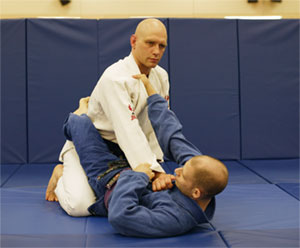







There’s a long-standing debate in the grappling community whether training with the gi helps your no-gi skills.
My personal preference is to train both with and without the gi.
And for what it’s worth, MMA super-coach Ricardo Liborio believes that anyone just starting out should train with the gi, even if their ultimate goal is to fight in MMA.
But today I actually want to focus on something slightly different…
Let’s assume that you’re interested in BOTH gi and no-gi. Or that you’re planning on doing some MMA sparring at some point. Or that you’d like your BJJ skills transfer well in a self defense situation
In this case you should be aware that some styles of BJJ translate much better to no-gi than others.
For example, the traditional sleeve and collar grip from closed guard works great in gi-based BJJ, but translates very poorly to no-gi. You just don’t have the same handles available to you when you’re wearing a rashguard and board shorts.
A lot of great BJJ players have gotten pounded in MMA, because they were so reliant on the gi. Without their familiar handles were unable to control their opponent’s posture in guard, and if you can’t control posture and distance in the guard then you’re to get smoked in the head for sure!
Now there’s nothing wrong with gi-dependent moves, so long as
1. You’re focusing on gi grappling or gi-based competition, or
2. you have enough time to develop a no-gi game that looks entirely different from your gi game
If you don’t have the time to develop two entirely different games then what you want is a game that works both in gi and no-gi contexts. For example, maybe specializing in a double-sleeve grip spider guard might not be the best idea…
Instead using grips like the underhook, the overhook and head control would much better. That’s because these grips work great both with AND without the gi.
The point is to make most of your game as transferable as possible!
So here’s your homework.
If you train with the gi more than 50% of the time, then go through your best offensive and defensive moves for each of the fundamental BJJ positions. Now ask yourself whether those moves are gi-dependent or gi-independent.
If more than half of your moves are reliant on the gi then I predict that making the jump to no-gi grappling could be a rough and difficult process.
In the end, of course, it’s entirely YOUR decision how reliant you want to be on the gi. Just be conscious about the consequences of your decision, that’s all…