Grapplearts Home | Grappling Videos | Articles | Techniques | Featured Photo | About Us | School Database | Links | Contact
Welcome to the Grapplearts blog! This blog exists to share a variety of different thoughts, opinions and techniques on a regular basis. If you are looking for the regular Grapplearts Resources found at grapplearts.com, click the link below. Read more...
  • Slider1
  • Slider2
  • Slider3
  • Slider4
banner1 banner2

banner3 banner4


Archive for the ‘training’ Category


Can You Actually Learn to Grapple from Youtube and Video Games?

Thursday, February 9th, 2012

Stephan’s Note: This article is by Grapplearts correspondent Bryanna Fissori, who has previously contributed a piece about MMA training at John Hackleman’s Pit, the home school of former UFC Champion Chuck Liddell.

In the midst of the rising popularity of Mixed Martial Arts with mainstream viewers has come a surge in a new kind of martial artist: the self-taught via television screen and computer monitor.

Mixed Martial Arts (MMA) began to rise in popularity during the early 1990’s, but due to lack of regulations including weight classes and rules in the cage, it was less popular with average viewer and considered by many to be human cock fighting. That image began to evolve over the next decade or so with implantation of the Unified Rules of Mixed Martial Arts, creating less of the violent blood-bath many would-be viewers avoided.

Today MMA widely accepted as a sport made up of numerous components extracted from a plethora of disciplines. Most practitioners of the game undergo training in a gym or dojo either specific to a single disciple or combined as an “MMA gym.” Either way, typical training across the board consists of cardio, strength, conditioning and of course technique. But today gyms are beginning to see an increasing number of students coming in to the sport with a background in “video martial arts.”

The increase in MMA’s popularity has triggered a boost in interest for many specific disciplines with some of the major players being Jiu Jitsu, Muay Thai and Karate, but instead of heading straight to the dojo some students are finding technique in the comfort of their own homes.

Youtube

Richard Bown Jr. trains at The Arena MMA in San Diego, California where he is endearingly referred to by his teammates as “Chavez” a nickname he was given by a teammate. His interest in training was sparked like that of many others. “I would watch it on T.V. and record anything U.F.C., W.E.C. or MMA related,” said Chavez. “In the beginning, for the first six months to a year the only training I got was on my own.  I got started because I use to play a lot of sports, but I was too small to play in college. With combat sports it’s different because you can find people your size.”

Being from the small town of Calexico, California Chavez did not have many options for training, so he resorted to other methods. “I watched a lot of Youtube,” said Chavez. “I would type in G.S.P. training and would watch how G.S.P. trains, or what someone like Freddie Roach is teaching. I would find out what the best people were doing for workout and I would do what they were doing.”

To practice the moves Chavez would borrow workout mats from the school where his father was a teacher. “They were the little yoga workout mats and I would have to tape them together on the bottom so they wouldn’t come apart. Then I would invite friends over and whoever wanted to come would come.”

Chavez training the Peruvian Necktie he learned on youtube at the Arena in San Diego with Coach Vince Salvador Two years into training Chavez (shirtless in the photo) has competed in two Jiu Jitsu competitions and one amateur MMA bout.  One of his favorite moves learned from Youtube is the Peruvian Necktie, which most Jiu Jitsu practitioners will contend is a difficult move to master from a hands-on instructor, let alone a computer screen.

Jai Troche trains at No Remorse in Honolulu, Hawaii. Despite being only 17, Jai has a wealth of martial arts knowledge well beyond his years, most of which has come from hands-on instruction, but has been complemented by external sources. He has nearly 20 fights/matches already under his belt.

“The Eddie Bravo stuff is pretty slick,” said Jai. “But if you have him as a coach you I’m pretty sure you would be able to do it a lot more successfully. There are certain techniques that work and certain techniques that don’t work for your own personal body type.”

So yes, fighters can and do supplement their training with techniques learned from Youtube, and so can you.  But now let’s look at an even more unlikely source of technical instruction…

Video Games

In addition to Youtube, student are also tightening up their skills via Xbox and Playstation. The UFC and E.A. Sports both have well-developed MMA video games which encompass virtually all the details you would find in a real bout. Players who have never touched foot a mat learn how to take down and past the guard to set up for the submission.

“One of the best things I learned from the UFC video game (UFC Undisputed) was the importance of distance,” said Chavez. “Throwing some punches and circling out.”

E.A. Sports Game Designer Victor Lugo shared the same sentiment in an exclusive interview with GrappleArts.com, “One of the things that is really stressed is the importance of circling.” said Lugo. “In the game if you circle into the opponent’s strong side you are going to be significantly more damaged than if you had circled away.”

Lugo explained that he and a number of the other designers for the game were brought on the team because of their background in specific martial arts disciplines. “We are able to capture how a fighter actually trains,” said Lugo, “Because so many of us train we can take the player through that process. There are real drills and real combinations that players have to work on to prepare for the fight in the game. It gives anyone starting in the sport a good idea of what to really expect when they get to the gym.”

Even though the work is being done through the push of a button, those buttons still force players to have knowledge of what will work situational. If one player shoots in, the other has to know how to sprawl. If a player gets mounted on the ground he needs to know the escape. To be successful in the game, players have to have a general knowledge of the techniques. They may not be developing muscle memory, but they are developing a mind set.

After the release of the UFC game Undisputed 2010 Producer Neven Dravinski stated in an interview with Game Focus, “Each match has this inherent tension to it. When you watch two really skilled jiu-jitsu fighters go at it, you can always see that attempt to gain position. . . When you see two people playing who really know the game, it’s scary how much like a real fight it looks like. There’s a really cool cat and mouse game going on that is really indicative of the tension and strategy in a real fight.”

Jai considers the best move he picked up from a game to be the rolling arm bar from back mount. “I thought it was a cool move.”

“The video games are really realistic these days,” said Jai. “So it teaches you decent technique. Not really great, but it’s a way to get knowledge of a position.”

About the Author:  Grapplearts.com correspondent Bryanna Fissori is the 135lb belt title holder for Fight Girls, Hawaii and also has a successful track record in BJJ and submission grappling competition. She trains at South Oahu MMA and Relson Gracie Waterfront Jiu Jitsu in Honolulu, Hawaii, and has been known to supplement her training with techniques she’s learned online.

IF YOU LIKED THIS ARTICLE YOU MIGHT ALSO LIKE STEPHAN KESTING’S INTERVIEW WITH MARSHALL CARPENTER FROM LOCKFLOW.COM: “LEARNING BJJ IN A DIGITAL AGE


A ‘Stupid’ Armlock I Was Pretty Sure Would NEVER Work…

Wednesday, February 1st, 2012

Sometimes you just gotta have faith…

In the first few years of my BJJ career I was shown the armlock in the video above multiple times.  And I always thought it was hogwash; that any good opponent would simply twist out of it and I’d end up in a terrible position.

I was always polite about it, of course: when someone taught it to me I would practice it a few times.  The whole time, however, I’d be inwardly groaning about how this ‘stupid’ technique would never work on a quality opponent.

Of course I never used it in sparring, and consequently I  never tapped out anybody with it, not even the scrawniest beginner whitebelt.

Then one day I was competing in a local tournament…

I tried to throw my opponent with a throw called Tai Otoshi, and when that didn’t work I pulled guard.  I then swept my opponent using the omoplata log roll sweep, and got to the top. Once in side mount I noticed that his arm was in the exact position for this attack that I’d written off so many times.  Almost in slow motion I shifted my grips, moved my body, and applied the submission.  He tapped out right away, and I was kind of blown away.

But my trust in this submission didn’t last.

Before long I’d convinced myself that this was a one-time fluke.   A coincidence.

And so, once again, I never even attempted that armlock in sparring.

(Despite my success using it against a tough opponent, and despite my 5th degree black belt instructor telling me it was a good attack, deep down I still ‘knew’ that it wasn’t a legitimate attack).

So there I was, secure in my knowledge that this was an ineffective attack.

Let’s fast forward to the next tournament. In that tournament I ended up fighting a big, strong, aggressive guy.  When we got our grips on our feet I remember thinking, ‘holy crap, this dude is strong.’

Somehow I got him to the ground and secured side mount.

Once again I noticed that his arm was in exactly the correct position to attack with this same armlock.  Slowly, methodically (and with an overwhelming sense of déjà vu all over again) I applied it.  Once again, it worked and he tapped out!

I might be a slow learner, but I’m not completely stupid.  It’s pretty hard to write off two successful attacks in a row leading to two tournament victories against big, strong, motivated opponents. I had to admit that this technique worked.  And that I’d been a bit of bonehead for writing it off.

Obviously when you’re building your game you can’t concentrate on everything all at once.  There just isn’t enough time. And that means that you’ve got to ignore certain aspects of grappling while concentrating on other aspects of your game.

So after a certain point in your development you SHOULD focus on your best moves.  Train with a purpose and don’t dilute your game by trying to get good at absolutely every technique, every position and every strategy.

But at the same time keep an open mind…

Have you heard of the “70/20/10 rule” that has helped make Google a multi-billion dollar company?  Briefly, it goes like this:

  • You dedicate about 70% of your time to your core business tasks
  • You dedicate about 20% of your time to other projects that still relate to your core business
  • You dedicate about 10% of your time to projects that don’t have anything to do with your core business.

I’m equating your bread and butter grappling game to Google’s core business tasks…

And I’m saying it’s worthwhile to spend about 10%  of your training time playing with different techniques and strategies that might seem really weird and wacky at first.  I’m officially giving you a ‘hall pass’ to occasionally creatively explore areas that have nothing to with your main game.

If one of the most successful companies in the world thinks that it’s OK for its employees to work on projects that usually lead to dead ends, then it’s OK for you to explore sweeps, submissions, escapes, reversals and other techniques that may seem exotic, impractical, or even foolish.

Being focused is a good thing. But keeping an open mind is good too!  Who knows, maybe that ‘stupid’ technique that would never work in a million bazillion years will save your butt someday…

Just like that stupid armlock that I ‘knew’ wouldn’t work saved my butt two tournaments in a row!

Click here for a video breakdown of this specific armlock, including the normal way it’s taught and a not-so-friendly, tournament-only version that puts incredible pressure on your opponent.

Pulling Guard in MMA

Saturday, December 31st, 2011

Q: Hello Stephan,

I’m a big fan of your website – I’ve been following it since 2009.  I compete in BJJ and No-Gi submission wrestling.

I’ve also been training MMA with hopes of having my first amateur fight within the year.  I’ve been very successful working my guard when I compete, and I’ve been able to often score submissions from there when I spar MMA.

With some MMA fighters pulling guard I was wondering if there’s a particular guard pull that works well in MMA (I’m not as comfortable in the half guard yet).

Thanks
Jerry

A: Hi there Jerry,

Thanks for your kind words about my website.  I never thought it would grow as big as it has become when I started it way back in 2002!

Now, with regards to pulling guard in Mixed Martial Arts competition…

The simplest thing to say is: don’t do it!!!!!!!

With one exception, I’m completely against pulling guard in MMA!

If you manage to successfully pull guard (and successfully pulling guard in MMA is definitely not a given) then the simple fact is that you’re on the bottom and your opponent is on top.

This gives him at least three advantages…

First of all, he can rest his weight on you.  All things being equal, that means that you’ll get tired faster than him.

And getting tired in MMA is a very bad thing.

As I said in my very first Grapplearts blog post ever, if you’re tired then you’re not fast, you’re not strong, you’re not explosive and you’re not even smart!

Secondly, he’ll have gravity on his side and that means he’ll be able to hit you much harder than you can hit him.

It’s true that sometimes your opponent trying to take your head off with his fists and elbows does opens up submission and sweeping opportunities.  But against a knowledgeable opponent in the slippery and sweaty world of MMA that can be a long shot.

(It’s also possible that your previous successes with submissions from the bottom during MMA sparring came, in part, from your training partners not punching you full force. Don’t underestimate how much getting punched in the face really hard will mess up your submission game!)

I don’t know what the exact statistics are, but I’m guessing that for every successful submission from the guard in MMA there have been three times as many KO’s and TKO’s resulting from the guy on the bottom getting pounded by the fighter on top.

Not great odds…

Finally, should your fight go the distance, most judges in MMA will give the fight to the guy on top because he’s supposedly being the aggressor.  Decisions don’t tend to favor the person on the bottom.

Now, there’s one important exception to all of this…

Let’s say that you’re totally outclassed in the striking or takedown department.  The fight isn’t going well and you’re gonna get knocked out on the feet, or end up completely exhausted by your opponent stuffing your takedown attempts.

If you know that you’re a better grappler, then your only option might be to get the fight to the ground quick. And the only way to do this might involve pulling guard.

So let’s talk about the right way and the wrong way to pull guard, regardless of whether you’re competing in BJJ or MMA…

Many people pull guard by falling backwards to the ground in a lazy kind of way.

This is dangerous because it gives your opponent the option of standing back and disengaging, in which case the referee will probably force you to get back to your feet again.  Or, even worse, he’ll take advantage of your lazy butt-flop and pass your guard, which could be disastrous in a real fight!

So you want to be sure that your guard pull works!

One option is to tie up (clinch) with your opponent and shoot your hips forward ultra-dynamically in an attempt to to get the closed guard.

Think of hitting him so hard that you knock him over backwards.  In all likelihood you won’t knock him over, but you probably will get to the closed guard.

It would also help if you had a solid half guard game.  Many times when you don’t get the full guard you end up in half guard.  And the half guard CAN work in MMA: watch the sweep that Antônio Rodrigo Nogueira (Big Nog) did on Tim Sylvia in UFC 81.

One final option I’m going to talk about today is something that I’ve seen work in both MMA and submission grappling.  Namely jumping to a leglock attack and/or to the single-leg X guard from a standing position!

This is a very surprising attack, with strong followup potential…

The goal is to submit your opponent with the leglock.  But even if that part doesn’t go according to plan, you still get to the ground, often ending up on top as your opponent tries to escape the submission attack.

Here’s a clip from my Leglock DVD taking you through that specific jumping leglock entry:

Before we get carried away talking about the specific techniques to pull guard, let’s make one thing really clear.  Regardless of the technique you’re using, if you’re even thinking about doing this in MMA then you’d better practice it first in sparring!

Here’s a drill that might help you (I previously taught this in “Lesson 4 – Escaping in Transition” of the Grappling Concepts Course).

This game is good for both partners.  It develops: A) effective guard pulling, and B) effective guard passing during the transition.

You and your training partner start on your feet.

Each person only has ONE way of scoring points in this game.

The first person’s goal is to pull guard.  If he can secure a guard position (any guard position, open or closed) for 3 seconds, he gets one point.

The other person’s DOESN’T want get caught in the guard.

His goal is to avoid getting entangled in the guard or half guard, and pass to a dominant position (side mount, kneemount, full mount, etc) as the other person transitions from standing to the the ground. If he passes the guard and maintains a dominant position for 3 seconds then he gets one point.

This is sparring with very limited parameters.

All one person is trying to do is get to the ground and maintain guard (or sweep him) for 3 seconds. All the other person is trying to do is not get caught in the guard and try to pass it even before it gets established.

After a pre-determined length of time you switch roles.

If you want pulling the guard in a match to be a last-ditch emergency option then this drill might be a good starting point for you.

But if your emphasis is MMA then you might want to mix it with some light boxing and/or clinchfighting with takedowns.

Also, you might want to award  the non-guard-pulling person ONE point if he breaks free of your guard and gets back to his feet, and TWO points if he passes your guard (this would reflect the severity of ending up in a bad position in MMA).

One last thing…

We’ve talked about pulling guard as an ace up your sleeve when nothing else is working.

Alright, we’re in agreement that it’s good to have a backup plan…

But if you want to fight MMA these days you need to have a striking game, a takedown game and a ground game!

Of course you’ll always be stronger in some areas than others – that’s completely normal, and is true even for the very best UFC fighters.

But if you only feel comfortable in one range then your opponents will eventually figure this out and clobber you.

Just remember, concussions are bad for you, and dental work is very, very expensive!  Train so that you got some options in all three areas of the game!

Take care, and good luck with your training!

Stephan Kesting
www.grapplearts.com

Advanced Submission Attacks

Monday, December 19th, 2011

Let’s talk about an advanced concept that top submission artists use all the time…

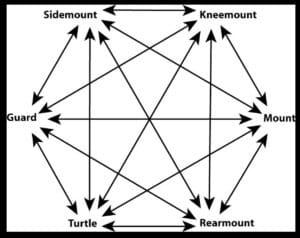
There are a only limited number of positions in Brazilian Jiu-jitsu.  The six most common positions are the Guard, Sidemount, Kneemount, Full Mount, Rear Mount and Turtle (click here to get a free book with a full explanation of this concept).

Now most of the time when you learn submissions – chokes, armlocks or leglocks – you start from one of these six basic, static positions.

And after you learn the mechanics of a technique, you then have to drill it to get your reps in, right?

Once again, 99% of technique drilling occurs from a static position.  You pick a technique, start in a recognizable position, and go through a series of steps until you end up locking on the final submission.

Drilling a single technique, step by step, with a partner in a specific static position like this is a great way to become familiar with the basic mechanics of a technique.

And there’s nothing wrong with this approach, at least initially…

But it’s NOT the most powerful way of applying these submissions.  You can do a lot better, and the key is that a lot of grappling occur BETWEEN positions, during the TRANSITIONS!

If you own the DVD series that Emily Kwok and I did on fighting bigger and stronger opponents then you’ll already familiar with the concept of defending and escaping bad positions during transitions (click here for a video clip about transitional escapes…)

Taking advantage of openings that present themselves during transitions is really important for advanced grappling.  And this applies not only to escapes, but also to the most exciting part of grappling, namely submissions.

Attacking with a submission when your opponent is on the move between formal positions is better because as he’s scrambling he’ll inevitably give you openings for your attack.  His defenses are down. He’s thinking about moving and scrambling, NOT about defending your submission.

In fact, your opponent often won’t even see the attack coming until it’s much too late.

I once saw Marcelo Garcia tap out a really good MMA fighter with a guillotine.  Marcelo slapped it on during a scramble.  Then the dude tried to cartwheel out of it which didn’t work.  He ended up tapping out in mid-air while upside down, with none of his limbs actually touching the floor.

That’s how quick a transitional attack can finish a fight.

Transitional attacks become even more important as you start fighting more skilled opponents and training partners.

Once people become familiar with a specific submission it becomes pretty hard to tap them out with it.  So you’ve got to catch them when they’re not quite expecting it (or at least not as able to defend)…

When people are safely settled down in a position they often become extremely defensive.  They tuck their chin, hold their arms close to their bodies, and are on the lookout for your attacks.

But movement creates openings.

Consider the guillotine choke for example…

Imagine sparring someone who is hunkered down in a really tight turtle position.  His hands are up, his neck is down, and he’s on high alert for any sort of attack.

How easy will it be to apply a guillotine on someone like that?

Right!  Not very easy at all.

But somehow your opponent must have gotten to that turtle position…

Maybe he shot in for a double leg takedown and you sprawled.  Or maybe you had him in sidemount and he turned in to his knees.  Or maybe he turtled because you were about to pass his guard…

There were probably a LOT more opportunities to get his neck while he was moving into the turtle compared to him being fully hunkered down in the turtle.  During that brief period of movement he’s much more vulnerable

This is a super-powerful concept.

The only  downside of this style of attacking is that that your game needs to be sharper…

You fight the way you train, so if you want to catch your opponent during the transitions between static positions then you need to have a deeper understanding of the game, drill transitional attacks, and be ready to jump on opportunities the split second they present themselves.

In the words of the famous philosopher Marshall Bruce Mathers III (also known as Eminem)

“Look, if you had, one shot, or one opportunity
To seize everything you ever wanted, one moment
Would you capture it?
Or just let it slip, yo”

Nailing a tough opponent with a submission is kind of like that…

Your homework is to take a look at some of the more common transitions in your sparring matches, some of the predictable scrambling patterns that occur over and over with your training partners, and figure out how to slap on some of your favorite submissions DURING the transition, BEFORE the position becomes fully stabilized.

This will really boost your finishing percentage, yo!

Which Grapplearts Instructional DVDs are the Hottest Right Now?

Tuesday, December 13th, 2011

Just in case you want to treat yourself, here are my top selling DVDs right now

1) THE NUMBER ONE SET: HOW TO DEFEAT THE BIGGER, STRONGER OPPONENT

The most popular DVD set of the entire year has undoubtedly been “How to Defeat the Bigger, Stronger Opponent” that I filmed together with multiple-time world champion Emily Kwok.

Trust me – there is SO much good material in this set, including techniques, drills, strategies, tactics, tricks, tips and training methods.

And all of it is designed to allow you to handle yourself against bigger, stronger opponents when you run into them in training or in competition.

(Since filming this material with Emily I’ve started incorporating a lot of her techniques into my own game, and they all work brilliantly!)

==> www.grapplearts.com/biggerstronger/index.php

Of course if you’re a regular reader then there’s a good chance that you already own the Emily Kwok DVDs. But if you liked them then you might also like one of these top selling sets…

2) THE GRAPPLING CONCEPTS COURSE

The Grappling Concepts Course is my flagship product.

If you like learning techniques, but ALSO want to know how to choose the right technique at the right time, how to do the little tweaks and adjustments that black belts do automatically, and have a method for making techniques easier and faster to remember, then you’ll LOVE this course.

In the course I show you my the highest percentage moves. These are the ones I use all the time when I’m rolling (both with or without the gi).

This training consists of 26 weekly lessons that can be viewed online, downloaded to your computer, synched to your mobile device and/or read as a PDF document.

And you also get 5 physical DVDs of additional advanced content that perfectly complements the concepts, techniques, drills and strategies being taught in the course itself.

More info here:

==> www.grapplearts.tv

3) DYNAMIC GUARD SWEEPS 2 DVD SET

The Butterfly Guard and X Guard are modern guard positions that totally get away from the old ‘lay and pray’ closed guard strategies.

They are favorite positions of Marcelo Garcia (who has been a huge inspiration to me and is actually Emily’s main teacher right now).

Whether you want to use the half guard offensively as an attack position, or you just want to know what to do when your opponent has almost gotten past your guard and you’re just barely hanging on with the half guard, you NEED to know what to do from half guard too.

The techniques in the 2 DVD Guard Sweeps Package dovetail together to give you a very powerful sweeping and attacking game.

The DVDs are packed with tricks, techniques, drills, and strategies. Together they’re over 4 hours of material that will keep you learning for a long time. (I just got an email from someone who’s still referring to the first DVD, 5 years after he first bought it!)

A complete guard game in a box:

==> www.grapplearts.com/Guard-Sweep-DVDs.php

4) HIGH PERCENTAGE LEGLOCKS

The theme of the year seems to be how to get an edge when you’re smaller, weaker or less experienced than you opponent…

I’ve always said that leglocks are the great equalizer. If you’re going against someone who’s been a BJJ black belt since before the first UFC, then – hands down – your single best chance of tapping them out is by using a leglock.

And the same goes for size…

A TON of David vs Goliath grappling matches have ended suddenly when the smaller guy saw a leglock opportunity, jumped on it, and tapped the big guy out.

Finally, the leglock game meshes EXTREMELY well with the Single Leg X Guard position that’s recently becoming so popular (and is a core position in the Emily Kwok DVDs). Keeping your opponents guessing whether you’re going to sweep them with the Single Leg X Guard, or tap them out with a lightening quick leglock, is a very good combination.

High Percentage Leglocks will give you a rock-solid leglock game, including the ability to attack with AND defend against some of the fastest, most effective submissions in the grappler’s repertoire.

I’ve sold this one DVD for as much as $49.95. But if you use ‘XMAS’ at checkout that’ll drop that down to $33.71.

More info here:

==> www.grapplearts.com/High-Percentage-Leglocks.php

Take care

Stephan Kesting
www.grapplearts.com

The First-Ever Grapplearts Q & A Podcast!

Friday, November 25th, 2011

Hey guys!

Here’s something different: in November of 2011 I answered questions from my newsletter readers (sign up for free here) on the first ever Grapplearts Q & A Podcast.

Find out how how to taper for competition, what to do when you’re getting crushed all the time, what to do when your wrestling coach wants you to stop doing BJJ, and how to remember all these bloody techniques…

You can listen to, or download the audio by doing one of the following:

1. Hit play in the middle of the black bar (the audio player link) at the bottom of this list, and/or

2. Right click on this link and select ‘save as’ to download the mp3 file to your computer, and/or

3. Subscribe to the Grapplearts Podcast in iTunes (and also listen to previous audio interviews).

Wait for it, wait for it… A black bar with a play button should appear right below this text in just a second or two…

Top Ten List Concluded: Why We Grapple…

Sunday, October 9th, 2011

We sweat, strain, get injured and spend money in order to roll around on the ground with men wearing pajamas.

(Or worse: men wearing spandex…)

So why do we do it?  What’s behind this bizarre fascination with grappling?

In ‘Blood, Sweat and… Sparta!‘ I take a stab at answering these questions.

And then, in a sister piece that doesn’t have much to do with grappling, I go off on a wild tangent (‘Bears, Belugas and an Offshore Tide on Hudson Bay‘.

These are the last two entries in the Top Ten Grapplearts Articles List that I’ve been sharing with you over the last little while. And even though I cheated by linking to two articles in one blog post, I still suggest that you check them out at the links below:

ARTICLE 1: Blood, Sweat and… Sparta!
http://www.grapplearts.com/Blog/2010/11/598/

ARTICLE 2: Bears, Belugas and an Offshore Tide on Hudson Bay
http://www.grapplearts.com/Blog/2010/11/609/

P.S.  The original blog comments for these articles were lost after a Facebook update.  But it’s fixed now, so please add your voice your opinion to the conversation in the Comment With Facebook’ section at the bottom of each post.

Top article #3: When you can’t train…

Sunday, September 25th, 2011

To get really good at grappling – black belt level, say – takes something like 10 years of concerted training.

That’s a long time!

And the fact that it takes this long is both a good thing and a bad thing…

It’s good because you probably won’t get bored of the the art.  Grappling skills are deep, rich and complex.  If you finally master one thing you’ll soon discover that there’s yet another area for you to work on.

You can pretty much continue to learn forever!

But the fact that you’ll be training for years also means that it’s inevitable that your training will get interrupted at some point…

Maybe you’ll get injured, maybe your job will occasionally get in the way of your training, or maybe family issues will require your undivided attention for a while.

Your training will have its peaks and valleys.  Sometimes you’ll train more and sometimes less.  And sometimes you won’t be able to train at all, which can be maddening for a hard-core grappler!

But there ARE things you can do to keep your head in the game – and even improve – during the times when you can’t physically get on the mat.

To help you out when this happens, here are some concrete tips, tricks and advice to survive a training layoff

Or if you would prefer a direct link, here you go!
www.grapplearts.com/Blog/2011/07/how-to-survive-training-layoffs-from-grappling/

Take heart and take care
Stephan Kesting


The Cheapest Grappling Mat

Monday, August 22nd, 2011

I’ve trained on a lot of different types of mat in my day: wrestling mats, foam core mats, puzzle mats, and rock hard old school Judo straw tatami, just to name a few.

And I’ve also rolled around on a lot of non-matted surfaces including concrete, wood and carpet.

(Of all those surfaces, carpet is the WORST by far!!  The carpet burns you can get on your head, back and elbows are unbelievable, take forever to heal, and give your friends an infinite amount of snigger-material if they tend to reach dirty-minded conclusions anyway…)

If you do BJJ or submission grappling it’s very convenient to have a mat handy so you can squeeze in some drilling or a sparring session even when the place you normally train at is closed.

That’s why I’m sharing something that has worked really well for mel.  It’s a perfectly serviceable grappling mat, but is also cheap, super portable, and a lot of fun!

First, get a large tarp and some tent pegs that you can get at any hardware or camping store.  The minimum practical size is probably 10′ x 12′, and this is one case where bigger is probably better…

Then find a level grassy area and do a quick sweep to remove any rocks, sticks, nails or other unpleasant surprises in the grass.  Then stake out the tarp.

Drive the pegs all the way down in to the ground, because you don’t want to impale yourself or your training partner onto one of those puppies at the end of a particularly spectacular guard sweep!

Next comes an optional step.  In the interests of preventing the aforementioned skewering you might want to cover the ends of the pegs with something.

On the day that I took this photo I was using metal tent pegs with a sharp edge, so I placed a small orange traffic cones over top of each peg.

If you’re going to do this regularly you might want to find flat-topped-and-rounded plastic tent pegs, or put a small slit into tennis balls and fit them over top of the pegs.

Now go and train!  The grass provides cushioning, and the tarp prevents you from having to pick twigs and dirt off of your face all the time.

If it’s a nice sunny day, then so much the better.

Just take it easy, keep an eye on those tent pegs for both you and your partner’s sake, and remember that although this is a surprisingly soft surface it still just isn’t a good time to practice your suplexing.

Tarp: $10.

Tent pegs: $12.

Being able to train outside on a sunny day and dismay people passing by: PRICELESS!

Three Timings for Getting Out of Submissions

Sunday, August 14th, 2011

Yesterday I was reading a thread on a popular forum discussing MMA fighter Ben Henderson’s ability to slip out of submissions.  And I ended up posting something about the topic of submission defense myself, which I’ll share with you below.

(What I didn’t say on that post is that the topic of getting out of submissions is really near and dear to my heart just now, because it ties in well with a really cool product I’m getting ready to release.  But more about that another day…)

Anyway, here’s something that a lot of people don’t realize about countering or defending submissions:  there are at least three distinct timings you can use

1, You can shut down a submission early, or preemptively.  Let’s say that you’re using your guard and your opponent starts going for an ankle lock.  He encircles your ankle with his arm, and you can see what’s coming, but he hasn’t  You rotate your leg (the right way, of course) and your foot pops out before you’re ever in any real danger.

This is an early escape, BEFORE he applies the lock.  If you have a choice then shutting down a submission early, before it ever really gets started, is definitely the best way to go!

2, You can escape as your opponent is applying the submission. Back to the ankle lock: let’s say that he’s locked it on and is falling backwards.  If you can ‘hitch a ride’ and get to the top as he falls back and then squish him like a bug, then you’ve just countered it DURING the attack.

Escaping submissions as they’re being applied is the most under-utilized timing, but it can be very useful.  It’s just so much easier to do it now rather than during the next stage (i.e. when it’s fully locked on).

3, Finally  you can do a late, or AFTER THE FACT escape.  These aren’t as easy or as high percentage as escaping before or during, but you still need to know them.

Back to the ankle lock for sec; let’s say that he falls all the way back into a good position, gets on his side, starts arching, etc.  At this point you might be trying to uncross his legs and escape your hips out sideways, or (if it’s legal) apply a heel hook to one of his legs, etc.  Last minute, hail mary type of stuff

So there you go; I’ve just tripled what you need to know!  You might’ve thought you only needed one good counter to the triangle choke, the spinning armbar or the inside-out, upside-down, cross-collar Jehoshaphat choke.  But now you know that you actually need to learn THREE defenses, early, middle and late.

How to Survive Training Layoffs from Grappling

Thursday, July 21st, 2011

Life is a balancing act, and most of us have multiple priorities. We have to juggle BJJ with work, family life, relaxation time, etc. A couple of days away from training never killed anybody. In fact, we’re usually refreshed and eager to get back at ‘er when we return!

But sometimes the breaks are longer than a couple of days. Life intervenes, and before you know it weeks, or even months have gone by and you’ve only trained once or twice:(

It’s easy to get down about this and want to throw in the towel altogether, but hear me out. Training layoffs are normal, and ultimately inevitable. They happen to everyone.

Ecclesiastes (and the Byrds) had it right: “to everything there is a season.” It just wasn’t your BJJ season for a while…

I’m a black belt and a self-proclaimed ‘expert’ on grappling and BJJ. But this doesn’t make me immune to ups and downs in my own training.  One of my dirty little secrets is that my own training suffers every time I’m working on a new Grapplearts video. For example, I’m working on a soon-to-be-released video project right now, and because of the long hours spent writing, designing, filming and editing, I’ve been lucky to get on the mats once a week.

Kind of ironic, isn’t it? I’m working on a tool to give everyone else’s grappling skills a huge boost, but at the same time it causes my own skills to temporarily decline… (Don’t get me wrong, I’m NOT complaining about making videos. I work on these projects because I love doing them. I just hope that admitting this it puts things into perspective a little bit.)

You see, training layoffs and slow-downs no longer freak me out. I know that whatever is making training difficult will eventually pass and I’ll be able to get back into it full-bore! A BJJ black belt usually takes 9 to 12 years, so you’re definitely in this for the long haul. And on that timescale things are going to come up in EVERYBODY’S life, no matter who you are.

Let’s get a bit more specific…

Say that things get crazy for you at work. You’re putting in 70 hours a week at the office. You barely have time to brush your teeth, let alone sneak away three times a week for your usual training sessions.

It may take a few months, but then you finally get things under control and are ready to get your life back. Time to start training again!

I’m not gonna lie to you; your first couple of sessions probably won’t be pretty… In fact, there are TWO areas where you’re probably going to be most challenged in your game.

The first problem you’ll likely notice is that your ENDURANCE now sucks. You’ll be sucking wind bigtime when you drill, and especially when you spar. This inability to go for as long and as hard as you could before your layoff is partially due to a decrease in your objective fitness (by ‘objective’ I mean that you could measure it on a treadmill).

In the running world they talk about specific measures of fitness like ‘VO2 max’ and ‘lactate threshold.’ These are numerical values which tell you how fit you are. And if you haven’t been training for a while then all your numbers probably just went down!

In addition to these objective physiological factors killing your endurance, your ‘sports-specific fitness’ just went down too! For example, you won’t be moving as smoothly and efficiently as you were before your layoff. You’ll use muscle to pull off moves where once you would have used leverage. You’ll use strength instead of timing. You’ll rely on gross body movements where once you would have automatically made more subtle adjustments.

All this means that you’ll be burning more energy, which, of course, makes you get tired faster.

Now I said that there were two problem areas after a layoff… The second thing to go out the window when you don’t train is your TIMING.

It’s a mental thing.

Your opponent will start to pass your guard but your brain will be like the computer in the original Star Trek series (…computing… …computing… …computing…). You’ll remember the perfect counter to the guard pass long after the chance to actually use it has come and gone.

When your timing is messed up like this then your brain is soaked in molasses – always a little too slow and a little too late.

But the good news is that it will all come back to you. As I’ve now said many times, training setbacks happen to everyone. Your timing and your sports-specific endurance AREN’T gone forever; they’ll come back, I promise!

Remember that every Mundial medalist has had layoffs, and every UFC champion has spent time on the couch waiting for injuries to heal. If they managed to get back into it, so can you. To get back to your previous level you need to stay strong, believe that it will all come back to you, and KEEP TRAINING!

Here are some real life tips-from-the-trenches about what you can do minimize your loss of skills during these inevitable training layoffs and get you through the tough times. (I’ve included a lot of links to other articles, make sure to check them all out!)

Layoff Survival Strategy 1: Make Time for Grappling

There’s no doubt about it. The more you train, the better you get (provided, of course, that you don’t overtrain).

Friendly competition between training partners is the heart and soul of getting better on the mat. So if you don’t train as often, chances are that you’ll be left in the dust relative to most of your training partners.

Everyone continuing to improve while you stagnate can be very frustrating, and sometimes it’s a natural reaction to want to throw in the towel completely. The thought process might go something like “screw it, I won’t train until I actually have the time to do it properly.”

But this is a mistake…

Here’s a noted authority (that would be *ahem* myself) talking about how often you should train in a week:

“But let me reassure you that training once a week is much, much, much better than not training at all. You will maintain at least some of your timing and conditioning, and will be much further ahead when you can return to your previous level of training. Of course if you can augment your weekly training session with some cardio or strength training so much the better.”

So if you’re going through a crazy busy time, try to figure out a way to somehow sneak out and train once a week… Or once every two weeks… Or even just once a month…

My BJJ coach, Marcus Soares, calls guys who train infrequently ‘tourists’ and jokes about them needing a visa to be allowed into class. But it’s all in good fun. And the truth is that he’s still glad to see them…

Now it’s true you probably won’t improve much with once-a-week training (unless you’re a complete beginner). But at least it keeps your head in the game and prevents your skills from backsliding completely.

If you can’t train at your regular club because you’re traveling for work or pleasure, then you’ve got another option. Find a club to train away from home!

Many BJJ and grappling clubs offer drop-in training, especially for out-of-town training. There’s often a small fee – usually $10 to $25. But even if it’s a really high drop-in fee (I’ve seen up to $40) it’s still less than what you’d pay for a single person at a good restaurant, so just consider it part of the whole vacation.

And even a single training session in an unfamiliar club will give you valuable insight into how other people train. To find a school either use Google or search the Grapplearts school database.

Training in a new, unfamiliar club can be an experience worth going out of your way for!

For example, in a previous life I was required to travel across the continent to just outside of Lakeland, Florida. Once there, I worked in a gray office cubicle, chained to a computer, for 10 hours a day. There were no BJJ clubs in town at the time.

One of the highlights of my time in Florida was the once-a-week visit to Orlando where I would train with BJJ black belt Marcelo Grosso. I’d leave right after work and then spend 1 1/2 to 2 hours in traffic get to Orlando, but training at this club was a really cool experience! And it helped prove to me that my timing and sports-specific endurance wasn’t going to disappear overnight.

Who knows! If you train a few times at a new school you may even learn a technique or two with which to confound your training partners when you get home again!!

Sometimes the best way to get through a tough time is with a little help from your friends. Specifically friends who are willing to train with you at unusual times and/or in unusual settings.

Being physically flexible is a good thing in BJJ, but so is being flexible with your training schedule! And a little lateral thinking about where and when to train can go a long way. I’ve rolled with training partners who had full time jobs and could only meet me for 6 am training sessions. And late at night on mats laid down in my kitchen. And in police stations, the back of a friend’s factory, and on a tarp laid down on top of grass in the park…

Take a good look at your schedule. Being conscious about how you spend your time is incredibly important!!

Laura Vanderkam – the author of “168 Hours; You Have More Time Than You Think” – cites a poll in which the average North American thinks he/she only has 16.5 hours of leisure time in a week. But, strangely enough, the average American also watches somewhere in the range of 18 to 23 hours of television every week.

Hmmmmmm….

(I threw out my TV years ago. One of the best things I ever did: freed up tons of time…)

So let’s say that you absolutely, positively don’t have time to train. Fine. I accept that. I’ll even agree that it sucks and feel appropriately sorry for you.But not if you’re still managing to watch all new episodes of Entourage, Glee, and Dancing with the Stars, plus posting on Facebook five times a day. If you can do this then you DO have the time to train, and I’m a little less sympathetic!

Layoff Survival Strategy 2: Find Time to Exercise

Do anything you can to avoid becoming a sedentary blob!!!

When I was in Florida there weren’t any BJJ or submission grappling clubs in town. I’ve already talked about my weekly pilgrimage to Orlando, but another piece of the puzzle was the daily run. Almost every day on the way from office to hotel room, I’d squeeze in a quick 2 to 3 mile run on a trail around a pretty lake.

Running is such a good way to build up your endurance. It’s been called “the king of the exercises” for good reason… Some people find running boring, but I think that being outside makes it a lot more enjoyable for me.

Here’s a list of tips that might help you if you’re one of those people who ‘just can’t run.’

Here’s what it comes down to: human bodies are very adaptable and this is a double edged sword.

On the one hand, it’s a good thing because it means that our bodies actually respond and adapt to the stresses encountered in the environment. For example, if you lift a heavy weight every day then eventually you’ll get stronger and that weight won’t seem quite so heavy.

But our adaptability can also be a bad thing. For example, as a species we’re very good at accumulating body fat. Maybe this was a good thing when our caveman ancestors needed to store energy for the winter, but in the modern era we’ve got so much cheap food all around us that our programming to eat more works against us.

So if you spend your days driving a desk in an office and don’t counteract that with exercise then your body will adapt, but in the wrong way. Your metabolism will slow down, your body fat will increase, your endurance will decrease and your bones will get weaker. These changes will make life much harder for you when you get back on the mat, and put you at an increased risk for injury. So it’s really important that you find a way to include some physical exercise into your weekly 168 hours.

Assuming you sleep 8 hours a night, that leaves you with 112 hours of waking time every week. And from that perspective you should probably be able to squeeze in a couple of hours of straining and sweating somehow, right? And one or two hours a week are a hell of a lot better than nothing!

I don’t believe that holidays are an excuse to let yourself go. After all, cruise ships usually have treadmills as well as ridiculously overflowing all-you-can-eat buffet tables! In fact, I wrote a whole article about how to staying fit on holidays…

When it comes to working out you can do a lot with a bit of determination and improvisation. If you want some inspiration then check out the workout routines of these MMA fighters (some of these fighters are no longer active, but you might still get some good ideas from their routines nonetheless).

But don’t think that you have to do epic UFC-style workouts. When you’re under the gun, then do Yoga, running, crossfit, bodybuilding, Pilates, Zoomba, pole dancing or fitness bootcamps in the park, it really doesn’t matter!

The bottom line is to do something – anything – to keep moving.

Layoff Survival Strategy 3: Keep Your Mind Active

Yogi Berra said “baseball is 90% mental, the other half is physical.” And the same is true in grappling.

I’m not going to get into the nitty-gritty of it here, but there are no shortage of studies demonstrating the power of visualization. Basically, if you think about an activity hard enough, then your brain basically is ‘tricked’ into thinking that you are actually doing it. And that literally improves your objective performance of the task.

The take-home message is that the more you think about an activity, watch an activity, and research an activity, then the faster you’ll improve at that activity!

I believe that deliberately, attentively watching grappling videos – either footage of people rolling/competing, or instructional footage – is a form of visualization. And in the modern digital age there’s no shortage of online video, DVDs, downloadable instruction, etc. etc. that you can use to keep your mind sharp during layoffs.

Here’s some specific examples of how the internet helped my training. And while we’re on that topic, here’s some great advice on how to actually use instructional media to get better (plus a bit of background on what’s happening at the neurological level too):

I’m not saying that watching instructional DVDs and youtube clips is better than actually training. But doing something is a hundred times better than doing nothing! Unchallenged muscles shrink and get weaker. And your grappling brain works much the same way, so challenge your noggin any way you can. If life takes you away from the mats for a while, keep your chin up and your eyes on the prize. You WILL eventually figure out a way to train regularly again.

And since you’ll eventually get back to training I’ll leave you with a few tips on coming back from a training layoff!

Take care, and good luck
Stephan Kesting
www.grapplearts.com

Best Type of BJJ Guard for Beginners

Saturday, April 23rd, 2011

Vitor ‘Shaolin’ Ribeiro is a four time World BJJ Champion.  In MMA he held the welterweight title in Japanese Shooto.  And he has the Cage Rage lightweight championship belt proudly mounted on the wall.

So I’d say he’s got some pretty solid credentials…

On a recent trip to the Big Apple I crawled out of bed at 5:00 am.  This was pretty brutal, especially because I was still partially on West Coast time, which meant that biologically I was getting up at 2 am.

Why was I getting up this early?

You see, before heading to the airport I wanted to take Shaolin’s 7:30 am BJJ class.  So after showering, eating and packing I dragged my butt to class.  But despite the early hour it was totally worth it!

First of all it was a great class.  We worked some cool guard passes and guard pass counters, and the sparring was fun too.

And then after training Shaolin talked about what kind of guard a BJJ newbie should work on first.  He also shared some very interesting drills, concepts and details that are important for ALL skill levels, from brand-new beginner to seasoned black belt.

This was super-cool stuff, and I thought it would be great material for you!  I grabbed my video camera and started filming.

Here’s a unique 10:36 video in which this World Champion shares his approach to teaching the guard to beginners:

And while we’re on this topic, here’s a different article I published in Grappling Magazine a few years ago.  It breaks down four killer drills Shaolin uses to get ready for competition

What Getting Better is Really All About!

Saturday, April 2nd, 2011

I just got in from an awesome training session, but before I head out and enjoy the sun for a couple of hours I’ve just got to share this with you.  You see, a couple of days ago I heard a great quote that’s been rattling around in my brain ever since because it’s totally applicable to BJJ, MMA and submission grappling.

“To live through an impossible situation, you don’t need the reflexes of a Grand Prix driver, the muscles of a Hercules, the mind of an Einstein. You simply need to know what to do.” –From The Book of Survival by Anthony Greenbank

Becoming a good grappler also involves getting in shape and honing your timing, but mainly it’s simply a matter of knowing what to do.

For example,

  • If you’re mounted and your opponent is defending his neck and his arms, do you know what to do?
  • If you’re passing the guard and your opponent defends by flipping into an inverted guard position, do you know what to do
  • If your 250 lb opponent is defending the armbar by clasping his hands together, do you know what to do?

The list goes on and on…

Getting better at grappling simply means that there are more and more situations where you DO, in fact, know exactly what to do!  So keep on training, ask those questions, watch those videos, read those books and you won’t be able to stop yourself from improving.

Why Men Should Grapple Women (and Smaller Men)

Monday, February 28th, 2011

Here’s a very interesting email from a female reader that I thought I’d pass along…

Hi Stephan,

I just read through the article called “Why Should Women Grapple?

There are many good reasons listed and arguments made in that article, so I decided to take a different spin and offer a different perspective on the topic… That’s why I wrote up a quick article about why men should grapple women.

Why Men Should Grapple Women (and Smaller Men)

There are many reasons why women should grapple. It provides us with self defense techniques, it trains us to deal with pressure, and it is great exercise and stress relief.

But there are also many reasons why men should grapple women. It’s not just a one sided relationship.

When you’re first learning a sweep, it’s easier to practice on a smaller person. We’re usually the smallest on the mat. You can work out the bugs and refine your technique, just don’t launch us 10 feet into the air. Try practicing the move very slowly, smoothly, and with as little effort as possible. If you start with the biggest guy in class you’ll probably rush/brute force your way through the technique and miss many of the details.

Rolling with women will also tighten up your game. We tend to be flexible and can squirm and slip our way through spaces you didn’t know you had. Just because you’re using all your weight to pin us to the mat doesn’t mean we can’t put you back into the guard.

Women move well. We can’t pin you, so we compensate by developing the ability to transition in order to keep dominate position. If we’re good, you won’t be able to muscle us off. You’ll need to use proper escapes.

If a woman has grappled for any length of time she has probably developed good technique, timing, and the ability to relax. All are necessary for survival, since we can’t use size and strength. These skills minimize injury and make grappling fun. Let’s face it, we’d be crazy to stick with it if we spent 100% of the time on the bottom getting flattened into a pancake. If you have questions, just ask. If we know the answer, we’d be happy to share it with you. If we don’t, we are always willing to learn and find out more.

If you have an ego you won’t progress very far in BJJ. You won’t put yourself in a position where you can make mistakes, and therefore you won’t learn. You really need to let go of your ego if you roll with a woman using only technique. It’s OK to tap. We tap all the time.

I once had a guy tell me that I taught him how not to be a brute. He said that his game really improved because of that. That made my day. I’ve learned so much from the guys I grapple with, and I like the thought that I can give back.

About the Author: Kara is a black belt in Washin-Ryu karate, and has been training at Buffalo BJJ for four years, currently holding the rank of blue belt.

The Six BJJ Supplements That Really Work

Monday, January 10th, 2011

When it comes to supplements, most people either take nothing at all or far too many!

And most serious grapplers go through a phase of taking tons of supplements in hopes of boosting their jiu-jitsu game.

I went supplement-crazy myself about 8 years ago.   I was taking at least 50 pills and tablets each day, including thrice-daily multivitamins… Selenium… Reishi extract… Chromium picolinate… Turmeric extract… Branched chain amino acids… Phosphatidyl serine… Etc.  Etc.  Etc.  The list went on and on.  And I continued taking all these supplements for about 6 months

So what was the effect of all these supplements?  Did I get bigger?  Stronger?  Faster?  Did my jiu-jitsu game jump up a full belt level?

No! Despite the placebo effect (more on that later) I didn’t notice ANY improvements to my strength, energy levels or recovery times.

But I did spend oodles of money on various pills, tablets and powders…

Probably the only real effect was that my urine became very expensive!

Why do so many people take so many different kinds of supplements?  Here’s a few reasons off the top of my head:

1 – Wishful Thinking. Wouldn’t it just be easier if you could pop a few pills every day rather than doing the hard work to maintain a healthy diet, putting in time under heavy iron and doing cardio,

2 – Advertising. Bodybuilding magazines and fitness websites exist in order to sell supplements. I’ve followed this industry for the last 20 years and there’s ALWAYS the next best thing.  Last week it was fermented Siberian yak toenail clippings, and this week it’s 2,3-dimethyl-nitro-killyouquick.

These magazines and websites wouldn’t exist if they didn’t sell supplements.  It’s the advertising revenue that keeps them afloat and provides them with a reason for being.

But it’s not only the advertisements themselves – you can’t trust the ‘articles’ either.  Even if they’re not getting kickbacks directly for endorsing various products, the authors of these articles are financially tied to the well-being of the magazine or website.

3 – The Placebo Effect.   The placebo effect is known from medicine when a doctor ‘prescribes’ sugar pills to a patient and that person then experiences all sorts of positive results and improvements.

Basically a placebo is a drug (or a supplement) that works just because you think it’s going to work, not because of anything about the drug itself.

Scientific American summed it up by saying “belief is powerful medicine, even if the treatment itself is a sham.”

And every study that has ever looked for a placebo effect has found one…

The placebo effect is huge when it comes to sports supplements.  For example, there’s nothing more convincing than a friend who swears that a certain new product is ‘the bomb’ and urges you to try it too!

If someone tells you that extract of Saccharum edule helped 50 lbs onto their bench press then you might just want to rush out and buy yourself a bucket of that supplement too.  But Saccharum edule extract is just another name for table sugar….

4 – Faulty Research.  The wild claims made by the supplement companies and their cronies are usually backed up by so-called ‘research.’  But when you look at it more closely, this research is usually a just a single study (or a cherry-picked selection of studies which all back up the claims being made).

But a single study proves nothing!  And what’s even worse is that these studies are often small, poorly designed and improperly controlled experiments that nobody else has ever managed to duplicate.

And, by the way, the same people who did the study also own the company making the supplement…

That’s why in science nothing is ever proven until many different and unbiased researchers have found the same result.

I’ve spent enough time in academia and doing research to know how easy it would be for an unscrupulous individual to tamper with the results of a study to make it ‘prove’ whatever they want it to prove.

I could go on, but I think I’ve made my point.  When it comes to claims about sports supplements I urge EXTREME SKEPTICISM!!!  Distrust everybody

So, are there any good supplements you should be taking?

I recently had a conversation with Dr. Krista Scott-Dixon Ph.D. on the  topic of the science behind supplements.  We were trying to figure out which sports supplements have rock-solid track records.

(By the way, Krista is the research director for the Healthy Food Bank and runs the strength training site Stumptuous.com.  So she knows her nutrition inside-out.    And she also trains and competes in BJJ and grappling!)

Here’s Krista’s feedback about some of the supplements which have strong evidence for really working in a sports-enhancement context (plus my own comments)!

“Hi Stephan!

In order of preference, the supplements that have real science behind them are the following:

1. Colourful fruits and veggies (e.g. dark berries, dark leafy greens, beets, red grapefruit, etc.),

Stephan’s note: Absolutely!!!  The people I know who eat the least vegetables tend to have the MOST health problems.  And just for the record, potatoes and rice don’t count as vegetables…

2. Protein from varied sources – check (baseline 0.75 g/lb day for average people; 1 g/lb per day for athletes).

Stephan’s Note: that means if you’re an actively training 200 lb grappler then you should be consuming about 200 grams of protein every day.

3. Fish oil – yes, very useful. (5-15 g daily)

Stephan’s note: this is a LOT more fish oil than most people take.  Some recent studies suggest that you should be taking 900 mg of DHA, which is a component of fish oil, daily.  But the average fish oil capsule only contains about 100 mg of DHA, which means that you have to take about 9 capsules a day to get your DHA…

4. Vitamin D – 2000-4000 IU daily in the winter, purposeful sun exposure in summer.

Stephan’s note:  in the winter months I take about four vitamin D tablets a day, which works out to 4000 IU.  You definitely need Vitamin D if you live in northern climes, but don’t overdo it with this one – it IS possible to poison yourself with this vitamin if you take too much of it.

5. Creatine for athletes doing strength/power work.

Stephan’s note: I personally don’t take creatine all that often unless I’m trying to get ready for a specific event.  Also note that some people don’t respond to creatine, but for most people supplementing with 2 grams a day for a month will add about 5 lbs and a fair bit of strength if they’re also weightlifting at the same time.

6. Caffeine in SMALL doses (50-100 mg, about 1/2 to 3/4 cup coffee), 1 hour before training.

Stephan’s note: I don’t drink coffee, but if you’ve ever met me then you know that I’ve got a thing for dark chocolate.  So I guess I’m ‘supplementing’ with caffeine in my own way

There are other supplements of course.  For example, BCAAs (Branch Chain Amino Acids) are definitely well corroborated, but if folks get the first four items I mentioned right (or, frankly, even just the first two items), then things like BCAA are really just gravy. In my experience, almost nobody, even athletes, is really even doing #1 and #2 properly. Anyone who nails #1 and #2 consistently and correctly should see a significant increase in performance, wellbeing, and recovery.

And the big one, that trumps pretty much all others: SLEEP. If you get 30-60 min more sleep per night consistently, it kicks the ass of nearly any supplement! For the dudes in your audience, sleep bumps up regular endogeneous testosterone production more than just about anything else.”

Erik Paulson; an MMA Master Coach Shares His Secrets

Wednesday, December 22nd, 2010

Erik Paulson is an MMA Master Coach.  He’s trained tons of fighters competing at the highest levels of Mixed Martial Arts.  And he held the Shooto light-heavyweight title in Japan for 5 years.

He’s also my friend and a mentor.

Recently I asked my newsletter readers if there was something in particular you wanted to ask Erik.  (Hey, if you were signed up for the FREE Grappling Tips newsletter you’d have been able to ask questions too!).

Anyway, within 5 minutes the email floodgates opened and the deluge of questions started.  At last count there were more than 500 questions in the queue…

We just finished getting the interview ready for you!  Here’s just a bit of what Erik shares:

  • What training with the Gracies in their ‘garage days’ was like
  • How wrestling can improve your BJJ, and visa versa
  • The theory of the jiu-jitsu wheel
  • The strategic and tactical differences between catchwrestling and BJJ
  • The key to rapid-fire submission attacks
  • Erik’s philosophy on training with and without the gi
  • What’s the best time to attack with leglocks
  • Leglock safety tips
  • How to develop a fighter’s gameplan
  • Tips for defeating larger, stronger opponents
  • What training with Brock Lesnar is like
  • The best conditioning exercises for fighting and grappling
  • A glaring weakness (and fantastic opportunity) in today’s MMA game

-

There’s at least three ways you can listen to this interview:

1) Hit play on the video below, and/or
2) Right click on this link and select ‘save as’  to download the mp3 file to your computer, and/or
3) Subscribe to the Grapplearts Podcast in iTunes.

Thanks and Merry Christmas!

Confessions of a Reformed ‘Unco’

Tuesday, December 14th, 2010

I got some good feedback on the last post (Advice for a Frustrated, Clumsy and Uncoordinated Grappler) and want to share a couple of tidbits with you today.

Here’s what one anonymous Australian BJJ student in his thirties had to say:

—————————–

Hi Stephan,

Thanks for that cool post on BJJ for non ‘natural athletes.’  I think he’s come to the right place – that post should help him.

I too was a natural ‘unco’ as we say in Australia (i.e. ‘uncoordinated person.’)  High school sucked in many ways, but into my 20s and 30s, mindful training helped me overtake some of those former athletes, many of whom – now in their late 30s – are looking like Homer Simpson…

A BIG thing that helped me was ‘functional’ strength training, ie incorporating useable movement patterns and ‘instability training’ that challenges stabilizer muscles.  This included:

  • Kettlebells: for me the hype’s been 90% true. (backed up with solid programming, of course)
  • Yoga – mainly Iyengar and Ashtanga Yoga
  • Scientific stretching: PNF work, Pavel Tsat’s techniques: great for plateu busting
  • Sandbags
  • Gym rings- basic
  • Basic gymnastics, handstands, rolls, judo rolls, tumbling
  • Floor-to-ceiling bag
  • Rope-climbs – especially for grip work.

All this training is designed to correct the movement dysfunction created by a lifetime of chairs and playstation or video games (I was more of a reader).

And as you said, consistently following a program is super-important!

The main thing I want to get across is there’s so much ‘smart’ training information out there that can help people.  Scientific flexibility, functional strength, Tabata protocols, viking warrior conditioning, yoga etc…  I try to take a ‘Jeet Kune Do’ attitude to digesting it all – absorbing what is useful, discarding what is useless.

Strength and athleticism is TRAINABLE !!

—————————–

And here’s what Christopher said about plateau-smashing on the Grapplearts Facebook Page:

“This article really put things in perspective for me. Thanks!

I trained 1-2 times a week for a good while, having tons of excuses etc, for over 2 years back and forth. Stagnated. Also frustrated to see classmates advance and me not because of the lack of commitment. My own doing.

This week I have hit 3 classes and have 1 more to go. I am already feeling myself move better and seeing how things link quicker. I didn’t put in the mat time. I have mastered a craft off the mat and I can attest it took me about 8 years of every day, 10-12 hours a day to get there.”

—————————–

You can click here to follow all the discussions on the Grapplearts Facebook page. (And while you’re there, hit ‘Like’ too!)

Advice for A Frustrated, Clumsy & Uncoordinated Grappler

Tuesday, December 7th, 2010

——————-  A Question ——————-

Hi Stephan

I’ve recently started learning BJJ with some friends at their garage.  I am by far the slowest student.  We’re following a DVD series with very clear & thorough breakdowns of techniques.

I know that in BJJ, you drill, drill and drill some more, but it feels like everyday is my first day in class.  We have classes at least twice a week, and each class, a technique I had memorized a few days before I can’t pull off. Or a technique we just watched for that matter.

Have you taught any students like this?  Do you have any advice for me?  It’s very frustrating.  Also worth noting, I’m pretty clumsy and uncoordinated.  Thank you for your time.

Sincerely
G.

——————-  My Comments ——————-

Hi G.

First of all, congratulations on training at all.  I’m a huge supporter of garage training as well as learning from non-traditional sources like DVDs and the internet.

Of course it’s frustrating to compete with natural athletes (damn them all) but I’ve also seen some incredible transformations over the years.  People who originally had two left feet can and do break through to the next level, often reaching a very high level of skill.

Someone with a high level of athleticism has a head start on you for sure, but often these people don’t have the discipline to actually continue training for very long.  They get bored or distracted by the next shiny object and stop training.

It’s like the fable about the tortoise and the hare – stay the course and often you (the tortoise) will end up overtaking all those pesky natural athletes (the hares).

It’s also possible that the way you’re training and absorbing information might not be optimal for you.  Check out this article on learning styles in grappling and see if it gives you any insight into the best way for you to process and absorb information.

Here are two more suggestions…

First: try to train MORE often.  Three times a week would definitely be better than two.  You’re trying to wire your body and your brain to do a new activity, and the more hours you spend on a mat the better.  (Malcom Gladwell – the author of “Outliers” – contends that it takes 10,000 hours of mindful practice to master a new activity.  So take heart; this stuff takes a long time but it’ll be worth it in the end.)

The second piece of advice is to slowly add conditioning to your weekly training regime.  If you’re clumsy and uncoordinated then I’m guessing that you also avoid activities like weightlifting, running, soccer, XC skiing, etc.

Here’s a few insights on conditioning to get you started…

Getting more physical will have several benefits.  Your endurance will improve and that will allow you to better retain your mental game while sparring.  It will also improve your general athleticism which will help you close the gap with those pesky natural athletes!

Good luck with your training!

Grappling Concepts Course Re-Released!

Wednesday, November 17th, 2010

I’ve just reopened registration to the Grappling Concepts Course!!

In the past I’ve been worried about about running out of time to properly deliver this course – it is my flagship instructional product after all – which is why I’ve only opened it up for short periods of time (despite getting rave reviews from participants).

But I’m going to try making it available again, along with the five bonus DVDs you can’t get anywhere else.

If you’re thinking about signing up do it soon, because I really have no idea how long I’ll leave registration open.

Click here for more info about my most powerful grappling instructional product: www.grapplearts.tv. This material took almost 30 years of research and a solid year of product development to get ready to share – and I’m very proud of it!  It really is my flagship instructional product.

Sorry, It’s Gonna Get Worse…

Wednesday, September 29th, 2010

As you improve as a grappler you’ll go through phases of adding new techniques and strategies to your game.  These are exciting times, but the sad truth is that you’re usually gonna get worse before you get better.

Case in point: a friend recently called me up, wanting to do some sparring.

He’d just been training with Marcelo Garcia in NYC, and had a whole bunch of new techniques and strategies in his arsenal.  He wanted to see how this brand-new technology worked on a new victim.  I volunteered, and a few hours later we were on the mats sparring.

Well things didn’t go exactly according to plan, and  I ended up absolutely crushing him that day.  None of his new material could touch me at all

So what’ s the deal.  Does Marcelo Garcia’s material suck?  Is he a terrible teacher?  Am I invulnerable on the mats?

No, No and No!!!

It’s all just part of the normal learning progression.  When you learn something new it just takes a while to integrate it into your game.  The new techniques won’t come out as smoothly or as instinctively as your ‘normal’ game.  If you’re really giving the new material a chance then your performance will usually suffer, and you’ll get schooled by people you can normally hang with.

After our sparring session I told him: ” I can totally feel that you’re trying to incorporate new material.  You’re hesitating and moving a bit awkwardly.  I’m sure this will change – let’s see how you feel in a week.”

When we sparred the next time I had a much tougher time with him.  He had been drilling those techniques (including lots of targeted sparring).  Lo and behold, all of a sudden those new moves he’d learned became genuine threats on the mat.

So when you see a technique that you really like, don’t just try it once and then throw it out if ‘it doesn’t work.’  Accept that you might get worse before you get better.  Be patient, stick to your guns, keep on drilling the technique and your game will thank you for it!

Training MMA Skills Under Pressure

Monday, September 20th, 2010

It’s easy to train an activity when you’re calm, relaxed and not tired.  But being able to execute those same movements correctly when you’re fatigued and gasping for breath is something entirely different.

In this guest post, strength and conditioning coach Brendan Chaplin talks about some specific drills to train your skills under pressure.

———————————————————

Training MMA Skills Under Pressure, by Brendan Chaplin

———————————————————

One of the main areas in rugby league strength and conditioning training I utilize is the concept of ‘skills under fatigue’. This is very simple: the athlete performs the key game related skills and tactics under fatigue.

How do we train for this?

Well one of the ways is the integration of skill training with conditioning. When I am training my fighters I always try to utilise this concept within my sessions. So for example I will have fighters do circuits with general movements included within them such as powerbag throws, tackle bag drives, sled pulling, high pulls etc and also key movement skills such as jab and shoot, floor based movement with the bungee cord, clinching and pummeling and other key areas.

I also think there is a clear progression to this conditioning work. That is the clear integration of the technical and conditioning coaches work. So within a technical session you may be isolating some technical striking work. After 8 minutes you might move to a med ball circuit emphasising power development for 5 minutes duration. You would then switch straight back to more integrated work perhaps some jab sparring, before again switching back to conditioning work using ladders and hurdles to emphasise footwork.

I think this is the future for high level strength and conditioning for fight sports. Quick and smooth transitions between the sessions to allow the athletes to develop skills whilst under fatigue. I do believe this type of training is more appropriate for advanced athletes as clearly the beginners need to develop the physical literacy and the skill sets separately, build their work capacity over time, before being put into this type of training session.

I think the positives of this work are huge!

Lower volume of separate conditioning sessions required therefore more recovery time, greater specificity of training and also opponent specific training. You will also get greater athlete buy-in as well in most cases.

The cons?? This type of conditioning requires a greater understanding of the sport by the conditioning professional, so look for someone with a good MMA background as well as sound strength and conditioning background!

Sensitivity Training for Grappling

Wednesday, August 18th, 2010

Physical attributes are really important for Brazilian jiu-jitsu and submission grappling (a point further discussed in this article about physical attributes and BJJ).

Being able to feel your opponent’s intent and react to it even before he moves (like when he’s trying to bridge his way out of your mount) requires sensitivity.  In fact, sensitivity is one of the most important physical attributes in grappling.

So let’s talk about some ways to develop this mysterious attribute called “sensitivity.”

The tried and true method to amp up your sensitivity is simply to spend more time on the mat.  If you’re working with real-live opponents and dealing with real-live pressure and resistance on a regular basis then you will eventually develop sensitivity.

But if you want to specifically work on your sensitivity you can try sparring with your eyes closed.  By relying on feel, rather than vision, your sensitivity and spacial awareness will develop much faster than if you were always using your eyes.  (I often use this to handicap myself when I’m sparring with someone who has much less experience than me).

Another great method is to do drills with your eyes closed.

For example, check out these four relatively simple technique repetition drills that can all be done with your eyes closed (just be sure not to impale your partner with your knee during the guard passing drill!).

Maybe the most effective application of this idea is to do reaction-based drills with your eyes closed.

For example, let’s say that you’re trying to train your defense to a specific attack.  The specific type of attack almost doesn’t matter – it could be an armdrag from butterfly guard, an armbar from mount, or a standing guard pass.  The important thing is that your partner can apply it to you on both the right and the left side.

Start with your eyes closed – your training partner will start his attack, but you won’t know whether he’s going to your left or right.  You have a single, specific counter in mind, and as soon as you feel  the attack you respond with the counter on the appropriate side.

The idea of this drill is to bypass the normal circuit of first seeing the attack, then thinking about your counter, and then deciding to initiate your defense.

With severely limited options (i.e. right or left) and your eyes closed you feel the attack and then go directly to your counter.  I was using this training myself the other day with my good friend Ritchie Yip and it really helped solidify the arm drag counter we were working on.

If you’re looking for ideas on how to train this way, then take a look at my classic Grappling Drills DVD – almost all the exercises on this DVD can be ramped up a notch by doing them with your eyes closed!!

Q & A: Should I tape my matches?

Wednesday, August 4th, 2010

==> A QUESTION <==

“Do you think there’s much benefit to video taping myself in sparring sessions and then watching them later to try and pin point bad/good techniques, or stuff I need to work on?  One of my sparring partners argued that they are pretty pointless unless you get an instructor (or someone more advanced than myself) to sit through them and make the observations.”

==> MY ANSWER <==

That’s an interesting question, and it demands a two-part response.

First of all, YES, video self analysis is an extremely powerful tool.  In fact, it’s the secret weapon of one of my main training adversaries (I discussed this in some detail a couple of years ago on my blog – click here for the complete article).

And video analysis might be most useful if you have a dominantly visual learning style.  But there’s something else going on here.  Something far more important!!

Here it is:

Take responsibility for your own progress!!

A good coach can help you along the way, but when push comes to shove YOU have to do the training.  YOU have to do the thinking.  YOU have to figure out what to work on.

And take responsibility as soon as possible.  Don’t wait until you’re a BJJ brown belt before you start critically examining your own game.  If you’re a beginner, for example, you might only notice big giant mistakes like having terrible closed guard posture, whereas if you’re advanced you might notice more subtle details. But regardless of what level you’re at, you’ll probably discover something that you can use or improve on right away!

Of course it’s great if other people offer you some help along the way, but don’t become dependent on it. One of my favorite martial arts sayings is “Give a man a fish and you feed him for a day. Teach a man to fish and you feed him for his whole life.” We are talking about developing an approach that teaches you ‘how to fish’ when it comes to your martial arts training.

This philosophy goes beyond way video taping – there are tons of different approaches you can use to get better.  It’s the 21st century and information everywhere!  Good instructors are super-useful, but there’s no shortage of grappling books, DVDs, and online information. So get as much help as you can, but ultimately take responsibility for all aspects of your training as soon as possible.  I promise that you’ll thank me later!

How To Attract Women… To Your Grappling School

Tuesday, July 6th, 2010

Krista Scott-Dixon is many things, including being friend of mine, a student of BJJ and the brains behind a great fitness website called Stumptuous.com.

She is also a becoming a semi-regular contributor to Grapplearts.com.  In fact her latest great article starts like this:

“I am often asked two questions by well-meaning male instructors:

1. How do I get more women to join my school?
2. And once they join, how do I keep them?

Good questions.

Before I answer them, here are a couple of crucial things to understand.

But why encourage women in grappling at all?

It’s important to recognize that most of the features about your gym that make it welcoming to women also make it welcoming to the 95% of grapplers that aren’t 18-year-old, superfit, natural male athletes who will thrive no matter what you give them. (And those 5% will probably appreciate the improvements too.)…”

Flow Sparring

Tuesday, June 15th, 2010

Last week I had a short but fun training session with my friend Ritchie doing what we call ‘flow sparring.’

The rules of flow sparring are very simple: you have to keep moving and you can’t use strength.  You can’t hold a position for more than a couple of seconds and you have to move, even if it means you’re going to lose a good position.  And you don’t finalize submissions; you can go for leglocks, chokes and armlocks, but you put them on loosely so that it’s relatively easy for your sparring partner to escape.

The whole goal of this kind of sparring is to create movement, lots of it!  And by continually experiencing movement for the entire sparring session you’re improving your ability to scramble.

Scrambling is really important in grappling.  It’s the transitional twilight zone between established positions, and if you become comfortable in these transitions then you’ll start to see more and more opportunities to apply flash submissions, or find unexpected ways to lock yourself into rock-solid pinning positions.

(In his excellent book ‘A Fighter’s Mind’ Sam Sheridan describes Marcelo Garcia – the best pound for pound grappler active today – as “the king of scrambles.”  Watch some of Marcelo’s matches on Youtube and tell me if this isn’t true!)

Now I’ve actually heard some people say that flow sparring develops bad habits, and that one should concentrate instead on holding positions.

Of course the ability to hold good position is important, but fast-paced, seemingly chaotic transitions are always going to be part of the game. If you can maintain total positional control over your sparring partners at all times then your sparring partners simply aren’t good enough to challenge you.  If skill levels are closer then there will be moments when there is no position and everything is just a giant scramble.

Flow sparring is just a training method.  In an important match you wouldn’t fight this way: you might scramble, scramble, scramble, get a good position and then crush your opponent while incrementally ratcheting your submission tighter and tighter.  That approach combines the very best aspects of a mobility-based game with a positional game (this topic is further broken down in my mobility vs position blog post here).

A lot of people don’t understand the concept of training methods. Think of it this way: almost every martial arts instructor in the world has his or her students do pushups.  Does that mean that they advocate standing square to an opponent and repeatedly pushing them with both arms at the same time?  Of course not!

Pushups are a training method to develop strength and endurance in the arms and chest.

And flow sparring is a training method to become comfortable with transitions, to recognize opportunities in the midst of movement, and to develop that elusive ability to scramble effectively.