


An Article by Brad Parker
Brad Parker runs Defend University (www.defendu.com), a research and development group dedicated to the exploration of leading edge techniques and strategies for self-defense, security and defensive tactics.
You’ve found yourself in a violent encounter. If you are a citizen, he’s closed the distance on you and you’ve taken him down to avoid his damaging punches and kicks. If you are a professional, you’ve closed the distance on him and taken him down in preparation for arrest.
For some people, this situation is a bit like the dog that chases the car — now that you’ve got one, what are you going to do with it?
You’ve survived the first part of the storm and you need put yourself in a position to do any or all of the following:
- Keep him from hitting you, but having the option to hit him if warranted;
- Watch for his friends coming to his aid;
- Disengage if your safety requires;
- Hold him for authorities;
- Handcuff him (if you are a cop or security guard);
- Submit him.
First, Work for the Mount
In any altercation your first priority is to protect your head. For LEOs (Law Enforcement Officers) or other armed agents, simultaneously, you will be protecting your firearm. After your takedown, our second priority is to achieve the mount. This is a classic position that has you on top of the opponent with both knees astride his torso. In the photo below, the officer is said to be “mounted” on the bad guy. Confusingly enough, the bad guy is also said to be “mounted”. However, to differentiate we usually say that the guy who has the mount is “maintaining the mount”, while the guy who is mounted is “defending” or “escaping the mount.”
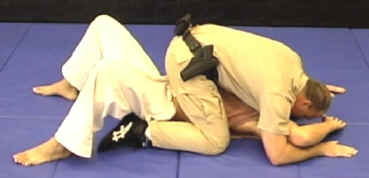 The ideal mount is done with your knees high up toward his armpits, both your arms out for balance, your weight is relaxed down onto the opponent’s upper chest and face. Stay off of his hips so you don’t get bumped up making you susceptible to be thrown off.
If you wind up in any other position after the takedown, you will want to either scramble to achieve the mount or deliberately work towards the mount if you have good control from cross side or North-South positions.
In case you have never been mounted, I can tell you that it sucks to be on the bottom. The top guy gets to use gravity, body weight, friction, and leverage to hold the guy down on the bottom. When mounted, most people expend an awful lot of energy trying to escape this position. The more they thrash, push and struggle the more quickly they fatigue and the more mistakes they make leaving them open for submissions.
Just to make things simple, you can mount him when he is on his back or when he is on his stomach.
Second, Take his Back
And therein lies the second part of this equation — you want him turned onto his stomach with you still mounted. By being mounted on his back, you can now achieve any or all of the six positive points delineated above:
- Obviously, he is in no position whatsoever to be able to hit you while he is face down.
- Keep your head up! Do a visual scan around to make sure his friends are not coming to test out their Doc Martens on your scalp. You don’t need to look down at him — you know where he is, you’re mounted on him!
- If his friends are coming or you need to quickly leave, you can disengage from the mount easily when he is face down. Don’t just stand up however. Swing one leg off of him and, while pressing your weight on his back to keep him on the ground, quickly push off of him to gain distance.
- By having his back, you can elect to hold him there, call for his hands for cuffing or work a neck or head restraint.
When you are on his back, however, keep your weight low down on his hips so he can’t come up on his knees and force you to slide over his head.
We’ve found that most people with wresting or judo backgrounds habitually turn over onto their stomachs without much effort on your part because they have trained not to “get pinned” (by the way, please do not turn onto your stomach when fighting. About the only positive attribute to this motion is that you are spared from seeing the blows as they rain down on you). If the attacker does turn over on his own, make sure you have a loose enough mount that he can rotate without catching your legs under him and dragging you over.
If the attacker doesn’t roll onto his stomach voluntarily, then we will have to persuade him to roll over.
Since we are working a scenario that assumes you have taken a VIOLENT person down (otherwise you would not normally be forced to mount someone), I will presume that there is hitting going on.
We’ve found that the most reliable way to make someone turn over is to repeatedly slap them in the face or on the side of the head. Most humans will naturally move away from pain and will turn over and cover their head with both arms. I would recommend open hand strikes to the head and face to protect your hands and to keep the punishment and damage to the opponent as minimal as possible.
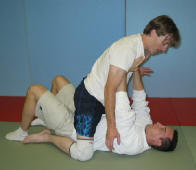
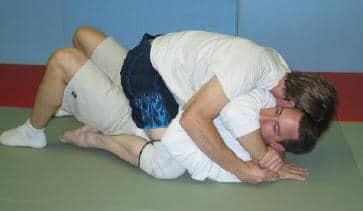
There is also an alternative to hitting. We’ve found that almost everyone will try to push you off of them (Figure 1 above). This is especially true if you focus on keeping your weight over him.
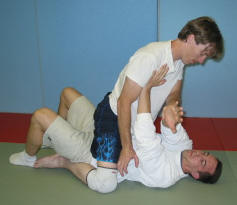
When they push you, it is very easy to knock their arm to the inside (Figure 2 above)…
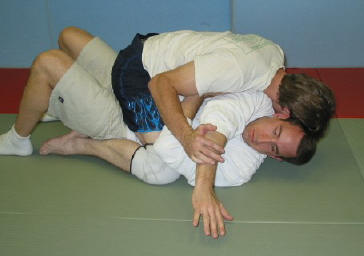 …and to use the side of your head and neck to keep it pressed harmlessly across their own chest (Figure 3 above) It is very difficult for anyone to get their arm back and their elbow to the floor once you have trapped it this way.
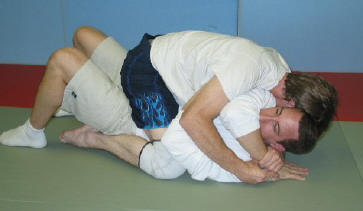
Reach under his head and grab the wrist of the arm that you are trapping and pushing across his face (Figure 4 above).
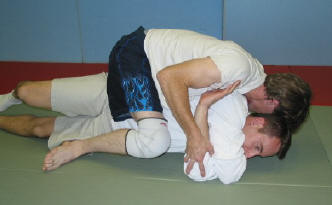 Use a combination of pulling on his wrist with your arm reaching under his head and pushing with your other arm on his trapped arm to start to roll him over to his stomach (Figure 5 above).I also use my chest to push on his shoulder to assist with the process. You’ll have to mind your mount and loosen up your legs to allow him to roll over onto his stomach.
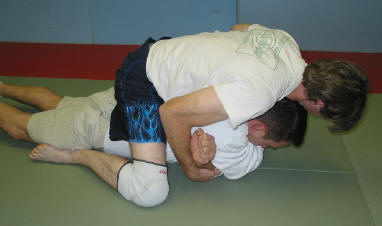 If you keep his arm tucked in tight to his body as you roll him over, he’ll end up rolled on top of it. (Figure 6 above). This is a great move for you because it traps his arm so he can’t use it to defend against your choke (ah, I mean, neck restraint) and it is very uncomfortable for him and it is sometimes difficult to breathe when in this position.
If the guy is not pushing you, you can still perform the same move by making him give you his arm. Take your forearm and blade it across his throat. Again, most normal human beings will move away from pain and push your arm off of their throat. That’s when you bump his arm across and perform the same technique as noted above.
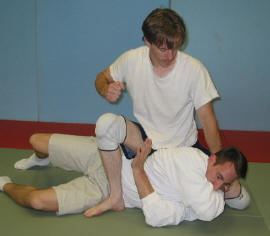
You also have the option of not taking him all the way over (Figure 7 above). In the middle of the roll you can stop when he is on his side. Sit up tall and pull up on the wrist that you are holding (your other arm will be completely free).You still have his arm wrapped around his own face and throat and now he is completely helpless and exposed to your strikes.
This is a savage position to be put in — you are helpless and your neck and spine are torqued at a painful angle. If you are training, you’ll get a lot of people to tap here. If you are doing it on the street you can hold the person here for quite a while. Make sure you keep your weight on him by literally sitting on him. Your knee on his back side should be up by his head and tucked tight against his back. The heel of your foot by his stomach should be snug up against his hip or stomach. Don’t give him any room to wiggle.
Try this simple process in training. When you have an end game in mind (mount, then take his back) it makes the process substantially easier when in the real fight.
Visit Defend University (www.defendu.com) for more information.