



There are lots of reasons to start doing a conditioning program if you’re training in BJJ or submission grappling.
The most important (yet often overlooked) benefit is to injury proof your body and allow you to train longer, harder, and more often. Other benefits can include increased strength, improved muscular endurance, elevated aerobic and anaerobic capacities, and more explosiveness, all of which will only improve your grappling game.
If you like your information in visual form then here’s a video I shot for a friend who wanted to start lifting weights. In it I go over the basics, how to do the most important exercises, and exactly how to put it all together into a workout.
So if you want to start training you might want to give this a watch:
Now if you’ve already doing strength and conditioning work in addition to your training then the rest of this article is probably NOT for you. You probably already have an exercise routine, and from experience you know what works for you.
But if you’re just starting out then choosing a style of strength and conditioning can be very confusing. Every expert has an agenda and a different opinion of what you should do.
There are so many choices: should you use dumbbells, barbells or kettlebells? Sprints or long slow distance training? Battle ropes or elastic cables? Crossfit or powerlifting? Long rest intervals between sets or continuous circuit training? The list of options goes on and on…
If you’re just starting out and are confused by all these choices then here are three general principles you should keep in mind…
1) FIRST, DO NO HARM
The concept of “First, Do No Harm” comes from ancient times (‘Primum non nocere’ in Latin). This phrase has made it into medicine’s Hippocratic Oath, but it applies equally well to strength and conditioning programs.
You CAN hurt yourself with exercise. It doesn’t matter if you’re talking about pushups, barbell squats, sprints, kettlebell swings or Yoga: if you do the exercises incorrectly then you can definitely seriously injure yourself.
The main things you can do to limit exercise-induced injuries include
- Make sure your form is correct. Get a coach, personal trainer or analytical gym rat to take you through the basics and make sure that you’re not contorting your body in such a way that makes injury almost inevitable
- Start slow and give your joints time to acclimatise to the novel stresses you’re exposing them to. It’s wonderful to be an enthusiastic novice, but don’t let that enthusiasm goad you into going so hard that you tear a muscle or damage a joint and then have to take 6 months off to recuperate.
- Be careful when you go above 90% effort. The closer you get to your redline the higher the chances of injury become. If you’re maxing out on a lift then make sure you’ve got a spotter or safety bars in place so that you don’t end up getting pinned beneath the barbell should you blow your lift.
Also choose your exercises carefully. I’ll get some hate mail for saying this, but when it comes to injury potential not all exercises are created equal. High-velocity drills like plyometrics and weightlifting exercises like the clean and jerk, the snatch, the upright row and behind the neck presses have a higher-than-average injury rate. Things can and do go wrong with these exercises even if you’re doing them with correct form, and if you’re doing them incorrectly then some truly spectacular and painful consequences are never far away.
If you’re determined to snatch your way to glory then you have to be prepared to seek out qualified coaches of Olympic Lifting, not someone with a 2 day trainer certificate hanging on their wall.
2) SECOND, DO SOMETHING YOU ENJOY
For the sake of argument let’s pretend that scientists determine the perfect conditioning regimen for grappling consists of 12 uphill sprints followed by 5 minutes of weighted baton twirling. They’ve checked all the alternatives, and nothing develops strength, speed, grip and cardio like the (hypothetical) sprint and twirl protocol…
But let’s also say that you HATE running up hills and DESPISE twirling batons, but you actually kinda like bodyweight callisthenics…
Then please, please, please go for the bodyweight callisthenics!
It’s much better to choose a conditioning activity that you actually enjoy (or can come to enjoy in a relatively short time) than it is to do something that you hate. The odds continuing to do an activity that you hate long enough to see a major effect are pretty small, and the chances that you’ll actually keep doing it and integrate it into your lifestyle over the decades are almost zero.
If you’re 6 weeks out from the World Championships and are looking for that slight edge, then go ahead and do stuff you don’t like to do. Hopefully the gain will be worth the pain.
But if you’re talking about incorporating fitness and conditioning into your life for the long haul, then pretty much any physical conditioning regimen is better than nothing, so find and do something you enjoy.
3) IT’S HARD TO GO WRONG WITH A WELL ROUNDED PROGRAM OF BASIC LIFTS
People are always looking for the next big thing, scouring Youtube and shows like UFC All Access for the latest tire flipping, rope swinging, sledgehammer wielding, pullup kipping, box jumping, kettlebell juggling, snorkel wearing workout extravaganza, preferably followed by an ice bath.
Now some of that stuff may actually even work, but I’m a big fan of the stuff that looks kinda boring on TV. The basic lifts like the squat, the bench press and the pull-up aren’t sexy, but they are highly effective and highly efficient.
The basic lifts not only make you stronger, but they will also lay down the basic movement patterns you’ll need if you want to try the fancy stuff later. For example, maintaining the correct curve of your lower back is easier to learn during the basic barbell squat than during more dynamic exercises like the clean and jerk or kettlebell snatches. The
When you’re starting a lifting program you want to make sure that your whole body is covered, not just the motions and body parts you feel are holding you back in your sport.
It’s usually a mistake to get overly sports specific in your conditioning because your sport is already conditioning your body. Gi-based BJJ, for example, tends to involve a lot of gripping and pulling. Consequently practitioners tend to disproportionately develop the grip and the pulling muscles of their upper bodies. If you now add a whole bunch of sport-specific training – tons of gi-based pull-ups for example – then you’re completely overdeveloping one half of your body.
A well-rounded conditioning program has the ability to strengthen the muscles and movements you’ll need for your sport AS WELL AS THE OPPOSITE BODY PARTS.
I sometimes like to express this as ‘having a push for every pull, and a pull for every push.’ This means that you balance every pushing exercise with a pulling exercise. If you’re going to bench press then you should also do seated rows or pull-ups. If you’re going to do bicep curls then you should also do something for your triceps. If you do a ton of crunches to strengthen your abs then you should also strengthen the spinal erectors at the back of your body.
For years I got good mileage out of twice a week workouts which went something like this:
- 10-20 minutes of hard cardio on a treadmill or stair master to warm up and improve my aerobic and anaerobic conditioning. This can be done as sprints or at a constant pace; so long as I’m sweating and out of breath by the end then I know I’ve done my body some good.
- 30 to 40 minutes of basic lifts (mainly squats, pull-ups, and bench presses). We’ll discuss this in further detail below.
- 10 minutes of finishing or ‘vanity’ exercises for abs, lower back, arms and/or neck.
The ‘Warmup’
Lots of people jump on the bike or the elliptical machine at the beginning of their workouts to warm up. And when they get off the machine they haven’t even broken a sweat. But unless you’re actually sweating and out of breath during your warmup then it’s basically it’s a huge waste of time. Time is precious, so you might as well be improving your cardio during your warmup.
Some people are worried that if they go hard during their warmup they won’t be able to move as much weight during their lifts. Don’t even worry about it.
If you’re a competitive powerlifter then you want to be pretty fresh for your weightlifting. But if you’re a grappler then endurance is ultimately the most important physical attribute. And if you can condition your muscles to be strong even when you’re a bit tired then that’s a good thing. After all, if you’re trying to muscle your way out of a bad position on the ground then you’ve probably already been through the wringer and you’re probably not going to be fresh and well rested then either.
If you’re a martial artist looking to improve your conditioning then there are many different options to improve your ‘cardio’. Whether you do sprints or go at a slower, steady pace is entirely a matter of preference – lots of people have had great results with both. And the mantra, as always, is that doing something is better than doing nothing.
When it comes to strength training there are three fundamental movements that absolutely need to be included.
- Pushing something away from your body (bench presses, pushups, dumbell presses, dips, etc.)
- Pulling something towards your body (pullups, dumbbell rows, lat pulldowns, seated rows, etc.)
- A lower body movement (barbell squats, lunges, leg presses, deadlifts, etc.)
These fundamental movements should make up the majority of your training. 80% at least at least should be dedicated to these multi-joint movements.
Then, if you have the time and energy you can throw in some auxiliary and ‘vanity’ exercises: bicep and triceps exercises for bigger arms, hyperextensions for lower back strength and stability, shrugs for stronger trapezius muscles, abdominal work for core strength and to look good on the beach.
Let’s take a look at some of my favourite basic lifts…
Squats (wide stance, narrow stance, front squats, back squats)
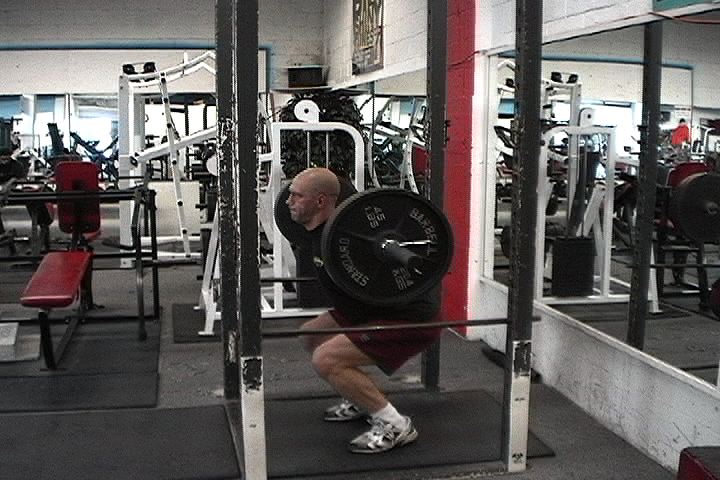
Squats are a FANTASTIC exercise, and have been a staple of my workouts for many years. I started out doing squats with a relatively narrow bodybuilder-style stance, but then gradually evolved into more of a powerlifting style squat.
However you can really hurt yourself if you do squats incorrectly. It’s a very good idea to have a coach, trainer, or experienced squatter to critique your form rather than trying to figure it all out yourself. Here are my top things to watch out for.
- Don’t let your knees wobble in and out. Do them in front of a mirror and watch your knees. Don’t’ let your knees wobble in and out as your body moves up and down – this is easy to miss if you’re not watching out for it
- Keep your back in mild lordosis the whole time. Don’t let the small of your back lose it’s backwards sway. To lock my back into a safe, strong position I stick my bum out backwards just a bit, slightly flare my lats back, and bear down with my abdomen.
- Lead with your head. When you’re coming up from the bottom of your squat make sure that you’re leading with your head. If your butt starts to rise up first (before your head) then you’re essentially using your back to lever the weight up, which is a recipe for disaster. If your bum comes up faster than your head you’re done: rack the weight and take a break.
Bench Press (wide grip, narrow grip, barbell, dumbbell)
The bench press sometimes gets a bad rap, probably due to the the gym rats who do this exercise to the exclusion of all other lifts in their quests for a bigger chest. (They also think that asking “whaddya bench?” is a socially acceptable way of introducing themselves to new people.)
But don’t let these meatheads turn you off this lift. Benching strengthens the chest, shoulders and arms, all of which get used quite a bit in grappling.
But people have lost teeth and broken their sternums doing this lift, so here are some safety tips:
- Unless you’re using a weight that you’re 110% sure you can handle, always do this lift in a cage with bars to catch the barbell should it roll out of your grasp for any reason. Dropping a loaded barbell weighing 100+ lbs on your chest or face will ruin your whole day, I guarantee it!
- In powerlifting competitors have to lower the bar all the way to their chest. In my experience this can sometimes lead to shoulder problems, so if it’s not part of your sport then don’t bother. Lower the bar till it’s a few inches off your chest, until your elbows are behind your body slightly, and then lift it back up. The few added inches for the full range of motion aren’t worth it IMHO.
- Never do a bench press on one of those swiss stability balls. This is an insane exercise that I see every once in a while. Any minor core stabilisation benefits you might derive from benching on an unstable surface dwindle in comparison to the massive risk you’re taking if the ball suddenly breaks with you holding the weight above your face.
Pullups (palms towards you, palms facing each other, palms away from you – refer to pull-up video)
In the bench press we pushed something off our body. In this exercise we’re pulling something towards our body.
If I’m doing multiple sets of pull-ups in a workout I like to vary my grips for every set. That way I’m hitting my pulling muscles in slightly different ways, hopefully mimicking some of the strange and wonderful ways that I’ll be pulling on my opponent in a grappling match.
Here are 19 variations of the humble pull-up:
Two Sample Basic Workouts
Let’s assume that you’ve got two days a week to do additional conditioning. To get you started here are two super-basic workouts that you might do in a week. Each workout takes about 50 to 60 minutes.
If you only had one day per week to train you could try doing the warmup followed by squats, bench press and pull-ups.
If you’re running short on time either take less rest between sets, or fewer sets per exercise.
This model served me well for years, but you’re a grownup so feel free to modify these exercises, sets, repetitions, etc. to meet your own needs.
Workout Day 1 – Cardio & Upper Body Emphasis
|
Workout Day 2 – Cardio & Lower Body Emphasis
|
Good luck getting started with your conditioning program. Be safe, and remember that doing something is almost always better than doing nothing.