


By Stephan Kesting
Originally published in Grappling Magazine, August 2001
 When did you start in Jujitsu and why
I started in 1970, when I was 13 years old at the Carlson Gracie school. I went to this school because my Uncle Herman was a friend of Carlson’s, and also because a friend of mine had started training there a couple of years before that. After I got to know Carlson I felt that he was not only a great Jujitsu instructor, but also a great person who eventually became a really good friend. This motivated me to keep training. The other part of the story is that I was always very competitive – as a boy I had competed in weightlifting, swimming and Judo – and this was a good outlet for my competitive nature. I got my black belt after 7 years of training
Isn’t that fast to get a black belt?
Yes, I think it is under the average.
So you trained only with Carlson Gracie?
Yes, only with him. At the time, though, we used to visit other schools to train with and compete against the other school’s students. At that time Jujitsu wasn’t too popular in Brazil, and you didn’t have enough students in the club to have a great variety of opponents. The quality of the Carlson Gracie students was very good always, and he used to have the best overall team in Brazil.
It can be really tough when you train hard for a whole year and there might only be one tournament. You are young, in shape, and there are so many attractions and distractions for young people in Brazil (laughing). To give all my hard training some kind of purpose I really had to look for different types of competition. My motivation came from my competitive spirit: some people have it and some don’t.
Technique 1: the reverse clock choke
So when you were training and competing, you did you compete only in Jujitsu?
I fought in Jujitsu tournaments from 1970 to 1981, but when I was studying in University I also competed in Judo. I was invited to become a member of the GF University Judo team by the president of the university who had also done Judo and knew that I did Jujitsu. This meant that I didn’t have to pay for my courses. This Judo scholarship allowed me to get two university degrees, one in Economics, the other in Physical Education.
My strategy, like a lot of other Carlson fighters, was to fight from the top position. I only jumped to the guard once in competition, and that was because I had a knee injury. I still ended up choking the guy though (laughing).
I stopped competing in 1981 because of knee injuries that eventually resulted in surgery – I felt that it was time to stop and concentrate on teaching.
Did you ever fight in any NHB?
No, not really. Vale Tudo competition was made illegal in Brazil in the early 1960’s. This type of competition only started again in the mid 1980’s, after I had stopped competing, so I missed the whole thing. Sometimes people would show up at the academy though, who didn’t believe in Jujitsu or were just tough guys. The doors would be locked and Carlson Gracie would put his best students forward to fight these guys. Often we (the students) wouldn’t be allowed to punch or kick, only the challenger could do that. We would have to take them down and get him to submit without hitting him.
How and why did you start instructing?
When I started Jujitsu everyone used to help the people with less skills. I felt I had a natural to teach, and soon I was helping Carlson Gracie teach beginners and kids. I have also used my university degrees to specialise in the art of teaching, which is not the same as being good in the art of Jujitsu.
Who were your training partners in Brazil?
Nobody knows the fighters from my generation – they stopped competing and not many of them are still teaching. I used to train with Carlson Gracie and Sergio Iris who was the all-time best Carlson student; unfortunately Sergio died last year.
Are any of your students from Brazil famous?
A few. Some old students with international exposure now include Marcus (Conan) Silveira, his brother Marcello Silveira, and Ricardo de la Riva who was known to have the best guard in Brazil. De la Riva has defeated Royce, Rolker and Royler Gracie in sport BJJ competition.
What about North American students
I am currently training two professional fighters, Denis Kang and Adam Tarsi, who have fought top quality opponents in NHB and done well. I am preparing more professional fighters, but this takes a little while because I have to make sure that students have the basics mastered before they fight NHB.
First comes the basic material of Jujitsu; after, if they want, comes NHB. The Jujitsu basics are very important to make a good NHB fighter – and it’s not just me that thinks that: all NHB fighters nowadays train in some form of Jujitsu.
Technique 2: the reverse shoulder lock
What do you do in a class (or to get students ready for competition)
Usually I teach a 2 hour class, and we start with 20 to 25 minutes of a very hard warm-up. After that I show lots of techniques for about 45 minutes, and then the rest of the class is sparring. That is enough for people who want to do Jujitsu for self-defence or just to stay in shape.
For the students who want to be top athletes and do well in competition I tell them that they need to do some extra training. They need to do running for endurance, sprints for anaerobic endurance and some weight training too. When I was in Brazil I didn’t only teach Jujitsu – for about 15 years I was a fitness instructor and personal trainer, so I have a strong belief in the importance of physical conditioning.
So what kind of training regime would you recommend to a student who wants to get ready for Jujitsu competition. What skills are important?
First they need to know the basics really well. Then there are many qualities that are important like flexibility, cardio, muscular endurance, strength and agility. Three qualities that are really important are (one) developing a sense of balance standing and posture on the ground, (two) the movement of the hips on the ground, and (three) to have a really strong grip. If you hold someone they should feel it; with a strong grip you can dominate the fight.
Are you happy with the development of your team in North America?
More than happy. The first tournament we competed in was after I’d been in Canada for only 6 months. Since then, only victories and victories. Not only in Canada, but also in the United States too. The only thing I would like is some more help from the sponsors: many students don’t have the money to travel and compete more.
It was really difficult to start my work in Canada because my students didn’t have high level guys to train with. In Brazil there are lots of black belts at every different weight. Here I had to start everything from zero, but now, after four years, we have some students with a very good level. I’m here with one mission: to create a strong Jujitsu team representing the Carlson Gracie team. Also to try to make a black belt student.
So do you think that you’ll bring a team to the Mundials, the PanAm’s….
I would like to do that, now that I have some good students who can compete on the same level as Brazilian guys, but it is a very expensive trip. I have no doubt that some of the students could achieve some very good results in the World Championships, the Brazilian Championships or the Pan American Championships
Technique 3: half guard pass and cervical choke
How are you trying to promote Jujitsu in North America
I’m trying to develop the art by teaching at my club and also by travelling and doing seminars. So far I have 12 representatives in Canada and the US, and I often go and do seminars in both countries. I have been invited to do a seminar in Japan too, and I hope I can organise that trip. I have been to Japan twice to coach Dennis (Kang) in his Pancrase fights and would love to go back.
You have been called the encyclopaedia of Brasilian Juijitsu, and certainly you show a tremendous amount of material in your classes and seminars. Why do you show so much material?
Look, I think that for a student to be good he needs a very large vision of everything that could happen during the fight. For every single technique that we practice I try to show the many possible reactions of the opponent: if he does something unexpected then you could have difficulties. I always tell my students to react to what the opponent does, and if they know a lot of technique then they will be able to choose the right reaction. I don’t believe in trying to force a technique that an opponent is blocking – that is just a waste of energy. It is very important to be able to save energy in a fight and then attack the right target in the right moment.
How did you end up in Canada
While I was teaching at the Carlson Gracie school in Brazil I had a visit from a foreign student who wanted to do some private classes with someone who spoke English. That was in 1996. She ended up inviting me to Canada because she liked the material I taught and the way I taught it, and in March of 1997 I came to North America for the first time and started teaching.
One hears about ‘Old Jujitsu’ and ‘New Jujitsu’, what do you think about this distinction. Do you think that there is a difference?
Yes there is a difference: in my times as a competitor the point system was different and all the fighters fought to get a submission. Today the fighters fight to get points, and if they get ahead by a few points they stall the fight. The main goal for the real Jujitsu fighter is to put his opponent out of action. In a tournament this means going for submissions.
Many fighters now just practise triangle chokes, armbars and sweeps, all from the guard. They jump to the guard, try the armbar, try the triangle, and if those don’t work, then they’ll try to sweep, get some points and stall the fight. This is why many Jujitsu fighters don’t do so well in NHB: they fight to sweep people. You can’t rely on sweeps to fight in NHB; you need to make life hell for your opponent.
I think that the rules of Jujitsu should be changed and that they should stop giving points for unimportant things. Maybe you should lose points for jumping to the guard, maybe you shouldn’t get points for reversals. If I’m fighting you and I almost submit you five times and you barely escape, and then you reverse me for 2 points and win the fight, what does that prove? Nothing! The main goal for a real Jujitsu fighter is to put his opponent out of action. In a tournament this means going for submissions.
Thank you for your time and giving us this interview
Thank you Stephan, I hope that this information tells people a little more about the history of Jujitsu and what we are trying to accomplish.
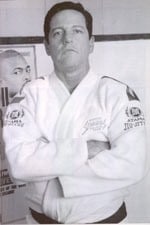
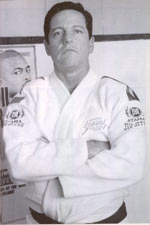
Marcus Soares is based in Vancouver, Canada, and is available for classes, private lessons and seminars. Please contact him at marcussoares@hotmail.com, visit his website at www.marcussoares.com or call him at (604) 618-6292. Helping Marcus demonstrate techniques is Dennis Kang, one of the premier NHB fighters in Canada
Reproduced by permission of Grappling Magazine