

– when a (small) girl meets a (big) boy –
by Krista Scott-Dixon
Stephan’s note: this article grew out of a conversation I had with Krista Scott-Dixon on Facebook about the special challenges faced by women (and smaller grapplers) when they spar bigger, stronger opponents.
There are other good articles addressing this topic on Grapplearts.com already (here, here, here, and here), but Krista’s advice was so well thought out, and so practical, that I got her permission to repost it here for my readership!
Enjoy!
Stephan Kesting
While more women are getting in to grappling, it’s still a sport dominated by males. And while in theory BJJ is a martial art developed with the premise that you’ll be smaller and weaker than your opponent, what do you do when you really ARE a lot smaller and weaker than most of your training partners?
Welcome to the situation faced by female grapplers.
Now, some of you ladies lucky enough to fight in heavier weight classes and those of you who’ve been going to kettlebell classes faithfully can often hold your own pretty well. But when you’re smaller and female, there’s a good chance you’ll find yourself frustrated as all your best techniques seem worthless against a 200 lb white belt who can simply (it seems) sit on you and squash you.
What to do?
I’m 5′ tall and I weigh 113 lbs. I’ve been training grappling for about 3 years now. I’m pretty strong for my size, and I’m no slouch, but eventually the laws of physics kick in. And it’s fair to say that I’ve been smushed under my fair share of opponents.
My advice here is aimed at smaller women in particular, but I think most women can identify at least a little bit with some of this stuff.
Size matters
The first thing to understand is that you MUST develop a different game to accommodate your body. This, of course, is true of all bodies — you must find what works for you.
It’s especially true, though, if your body has some kind of limitation, such as being smaller. (This can also be an advantage. More on that later). Your limbs will be shorter and you’ll have less weight to throw around. Many of the ultra-athletic moves that depend on brute strength won’t work for you.
They’re stronger. Be smarter. You need to be clever and use leverage. Work WITH your body, not against it. Use anatomy and biomechanics to find your opponents’ weak spots – attack those with your strong spots, such as your skeleton.
Conversely, protect your weak spots. Watch your fingers/hands and feet; never be on your back if possible. If a heavier person lands on your little hands, feet, or sternum, that’s bad news. Gravity is not your friend. Keep appendages tucked safely and protect your ribs and belly. (By the way, protecting your ribs will also keep your boobs safe. You don’t want the girls crushed either.)
Standup Fighting
In standup you might have to use slightly different grips or go for different throws. On the other hand, you might have a knack for takedowns — after all, you’re closer to their legs. If you train judo, this means that your opponents will have a tough time dropping low enough to knock you off balance. (Hope they have a good drop seio nage!)
Resist the urge to reach too high or too far in standup; instead, modify the throws so your grips stay close to you and your core stays strong. Use your forearms to drive into the opponent’s sternum when you take a collar grip.
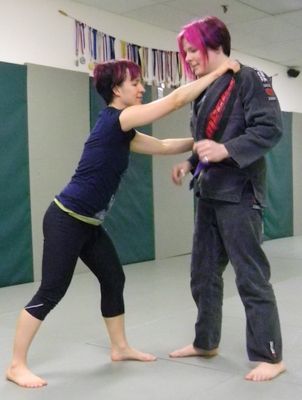
Worse: Here I’m reaching up to a taller opponent to grab her collar or head/neck. You can see how weak this makes my position. I can be pulled forwards; my shoulder is in a biomechanically less powerful position; and my arms are easily isolated from my core. There’s lots of space for her to turn in to a throw or drop for a takedown, and I can’t exert much force to stop her.
(Now, if you’re a superninja setting up some kind of wicked flying attack, and you can pull it off, go for it… but I suspect if you are reading this article, your superninja skills may not yet be perfect.)
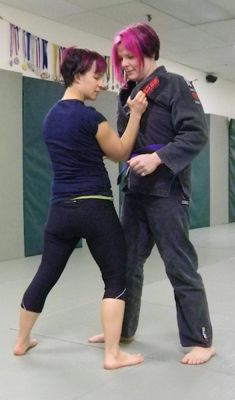
Better: My arms stay tight to my core; my forearm presses into her chest, along the sternum. I’ve got contact all the way from hand to elbow on her ribs. My hand is about shoulder level. My frame here is therefore much stronger.
Regardless of my opponent’s height, I’m going to take this position. The actual placement of my grip on their collar will thus vary. If I can get a deep neck grip with this stronger structure, then great. If not, I won’t bother with it.
Also notice the advantage I have here: My hips are lower than hers already. (As the judo people say, “Get your belt under theirs.”) This means it’s easier for me to set up a throw properly, and harder for her.
Don’t fear getting in tighter with an opponent in standup; if you can tuck your hips up and under theirs, you’re halfway to a throw.
Top game: Pressure and control
Gravity is not your friend. Use your body weight to do as much as you can but you’ll need to give it a helping hand.
Keep your base low and wide, because if you’re lighter you’re at risk of getting swept more easily. Also develop pressure techniques for the top game. This will often mean you have to come off your knees in the top position. You’ll need every last pound and inch of you!
Concentrate your entire weight in focused pressure points. This often includes driving some smaller, hard part of you into a part of them — such as knee on belly or its variation: knee in floating ribs or armpit when you have a top position but opponent has turned to the side. There are nerve bundles and soft parts in the belly/abdomen and armpit that don’t like knees very much. Too bad for them!
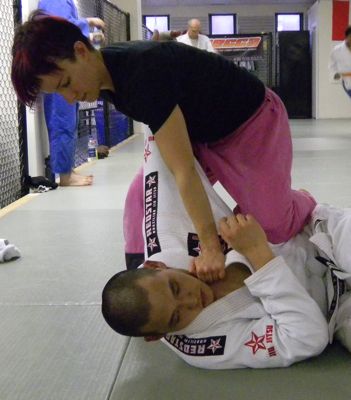
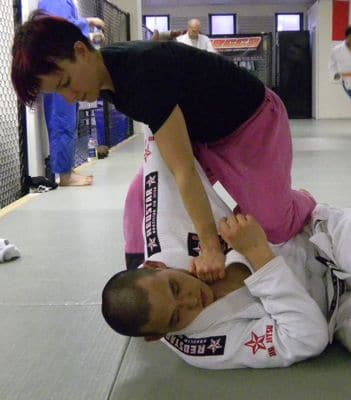
Here, my opponent is turning on his side. This gives me a perfect chance to drive my knee into his floating ribs. You can grab the gi collar and drive it down if you like.
Notice too how my arm is straight. I was being nice for the photo, but normally I’d drive my arm straight down right through my opponent’s face. In no-gi, I’ll push the head/face down with the palm of my left hand while gripping my opponent’s left tricep just above the elbow with my right hand.
When you’re taking side control, use your shoulder to control their head and face.
Mark Stables of MECCA in Toronto (formerly White Tiger) really got me into using a shoulder driven in the cheek to turn the opponent’s head away from me when I’m in side control top. Same thing when taking north-south: Use your ribcage and hip (depending on your exact orientation) to mash and control their head. I’ve actually tapped opponents just from this pressure. (Be nice with these ones when you’re just rolling. They’re very uncomfortable!)
Strengthening your side control: All it takes is a little shoulder
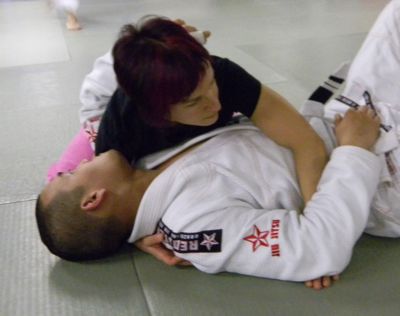
NO: I have no pressure on Michael. He can turn his head, which means he can turn the rest of his body. There’s lots of space between me and him, and he can easily escape.
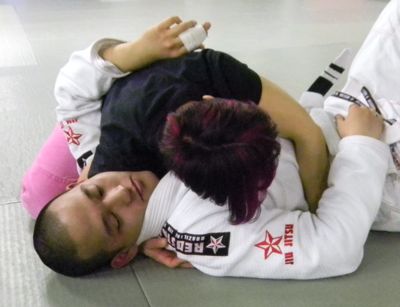
YES: My shoulder is driving into Michael’s face, pressing in to his cheek. I’ve turned my shoulder very slightly toward his feet to enhance this.
This prevents him from turning his head towards me, and also makes it very uncomfortable for. If you’re small, you might have a bony little shoulder that provides extra unpleasantness!
And here’s a tip from Felicia Oh, who is one of the best female grapplers in the world and not much bigger than me: Don’t drive your chest pressure straight down in side control top; drive diagonally in and down at a 45-degree angle — imagine you’re “smearing” their ribcage across the mat from the outside in. If you’re on their right side, start at the outer edge of the right side of their ribcage and imagine pushing your chest down and through to the bottom of the left side of their ribs.
This slight variation practically staples their thorax to the mat. You’ll feel much heavier to your opponent.
Applying pressure: It’s all in the angles
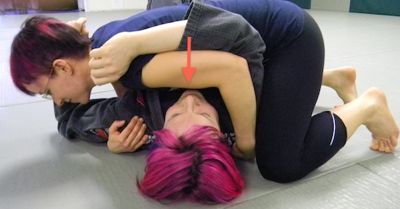
NO: Here I’m in top control side. My base is high, and my weight is forward. There’s space between my shoulder and my opponent’s head. It’s easy for the bottom person to frame out, and sweep me in the direction of my head.
The red arrow shows the direction of my pressure: straight down. This isn’t as effective if I’m small. I just don’t have enough weight.
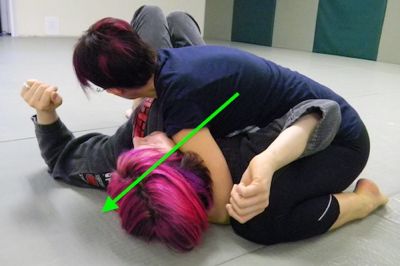
YES: This is a much stronger position. I’m applying pressure diagonally downwards, from the outer top right of my opponent’s body, pushing through to the bottom left (green arrow).
Also notice that I’m sitting back into my hips, low and wide. I’m isolating her right shoulder by tucking it into my hip crease and getting my knee behind/under it (see “Divide and conquer” below).
And there’s that shoulder in the face again!
Experiment with using the wrestler’s sprawl position as often as you can for things like passing guard or holding north-south. Drive hips down. Down. Really down. Is your ass on fire? Do you feel like you’re humping the mat? Good. (Just to be on the safe side, drive them down a little more.)
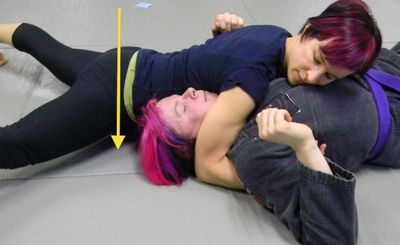 Here I’m taking north-south top position. Notice how I’m off my knees, pushing hips down into the mat (yellow arrow shows the direction of hip drive). Also notice that this comes from the hips, not the low back. I’m pinching my opponent’s head tight between my right arm and right hip.
Check out some judo pinning techniques, as these are often very good control positions for grappling. Now in judo, you pin the opponent for nearly 30 seconds to win. In grappling you’d get called for stalling, but you can certainly use these pins to transition or settle in to a more secure position. After all, if it’s something you can hold for half a minute, it’s gotta be good.
Develop a roster of more aggressive control techniques in various positions, e.g. in back control go right for the RNC grip; don’t waste time and energy setting up more strength-intensive things that presume a lot of ability to control the opponent. Another tip from Mark Stables: “Climb” your forearm up their face, ideally at the top or bridge of their nose, to move their head when they’re tucking their chin to defend your back attack.
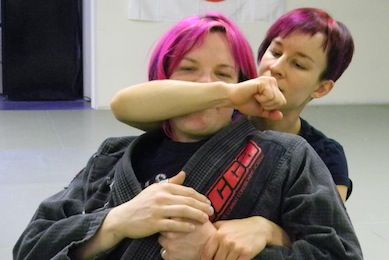
Starting to open up their chin tuck. Place your forearm at the bridge of their nose and pull up. If you have the rest of them controlled, this lets you start to set up a choke by sliding the other arm in under the neck.
Closed vs open guard
Forget closed guard unless you have super long legs; I often can’t even lock my legs around a larger person. I am all about the open guard. It’s also a lot harder to hold an opponent in closed guard even if you can close your ankles; it takes a lot more strength to “Thighmaster” a bigger opponent determined to escape than it does to stay mobile and block them in open guards.
Passing the guard
The plus for smaller people here is that our legs can get in between us and our opponents. My opponents are driven insane by my little knees poking in everywhere. This gives you chances to play open guard but it also gives you a nifty guard pass, if you’re in a larger person’s guard.
Knee-up-the-middle: The small person’s guard pass
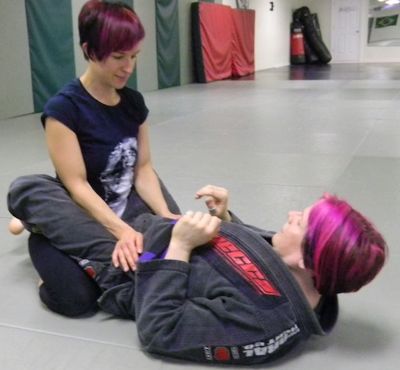
Step 1: OK, so here you are in closed guard. Maybe they’re even breaking your posture. Don’t worry. This one will work even if they’ve got your head mashed down.Walk your hips back, staying low and wide to make space. All you need is a small space between you and your opponent’s hips. You’re not trying to crack this guard open at the ankles (although of course that’d be a bonus); you’re going to go up the middle.
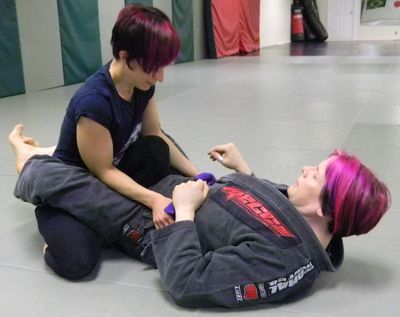
Step 2: Shift your weight, staying low and wide, and pop your knee up and through the space you’ve created by scooting back. Sit back on your butt.See how her ankles are still crossed? I don’t care! Now, no matter how hard she squeezes, she can’t stop this pass unless she has some other clever defense.
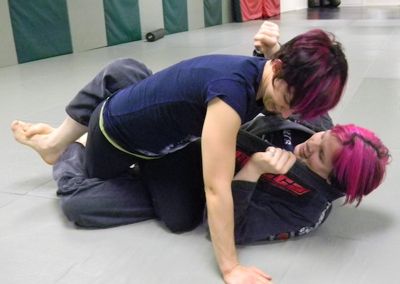
Step 3: Slide the knee over to one side or the other to pass. Here, I’ve chosen to start passing crosswise over her left thigh. Don’t fergit yer underhook on yer left side!
Movement
Be mobile and agile — if you get pinned you’re screwed, so keep moving and anticipate the progression of their top game. For example, if they’re passing your closed guard and coming around to side control, don’t wait for them to get full side control then work to escape. Once that happens and their weight settles in on top of you, it’s too late. (See the side control prevention sequence below.)
Your game is often in the transitions, because that’s when a heavier opponent gives you the chance to do stuff. You might have to wait for them to move in order to get an opening. If you’re really stuck, don’t exhaust yourself by freaking out and trying to push them off you. Lie in wait like a little cobra. Then, when you feel the weight shift or something move, GO!
Keep them moving but not by trying to move them. (More on that later.) Keep them chasing you and trying to deal with your movements. Don’t let them settle.
I like a technique I call “earthquake building”. Ever seen slow-motion footage of a building swaying in an earthquake? Imagine trying to stay balanced while standing on top of that swaying building. (I’ve also heard something similar called “magic carpet”, because it pulls the rug out from under people.) Unbalance them as much as you can, simply by not giving them a firm foundation. Keep squirming like a little wiggly worm!
You’re playing a game of inches here. You can’t make big, dramatic sweeping movements, so you’re going to have to gain and defend positions by erosion. Get half an inch of defense, then another, then another, and another. It adds up.
Control and isolate a small part
If you’re a small female then don’t bother trying to attack your opponent’s entire body. Divide and conquer. One of my favourite things to do is just focus on controlling the head/neck or a single shoulder. Here I also find some judo stuff handy because they have a lot of dirty little joint isolation tricks.
Head control is especially important: If you control the head and neck, you control the entire spine. You can’t hold their whole body, so forget it. Control their cervical spine instead: then you only have to worry about a few small muscles and bones. Use larger parts such as your forearm or knee to hold and turn their cheek, jaw, and chin.
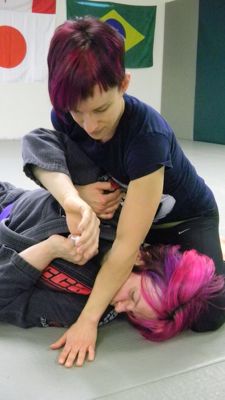
Slide your arm down along their face, smearing your forearm down their cheek/jaw and keeping it tight to their face.
This controls the bottom person and prevents her from turning in to me as I set up the side armbar.
Framing FOR FEMALES
Framing is your friend. Frame like a fiend.
Never, ever be on your back. Even if all you can do on the bottom is curl into the fetal position and assume what I call “squirrel posture” (upper arms tucked tight to your chest like a squirrel clutching a nut), that’s better than nothing.
Collarbone pressure on the opponent is a great frame for a smaller person. The collarbone is a thin, sensitive bone that can’t take much pressure, plus you can also dig in to the throat (see? head and neck control again!).
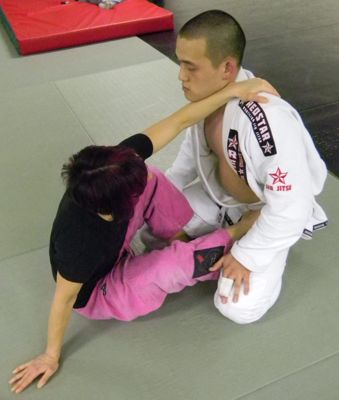
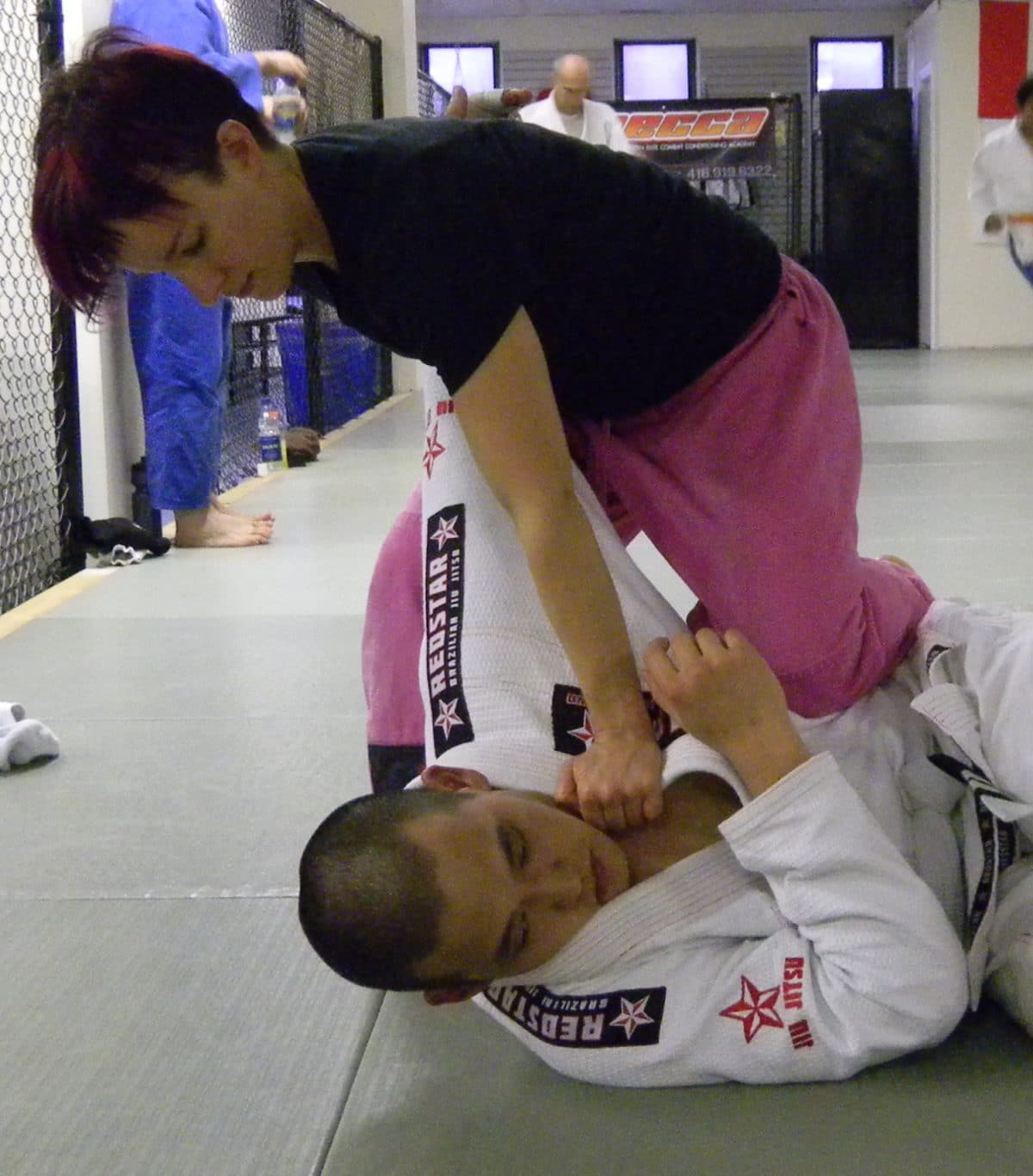
Collarbone frame: Grab the opponent’s trap (or the gi if you use it). Forearm is tight under their chin, pressing into their throat and collarbone. You can control their head by simply raising your elbow. Drive the “blade” of your wrist and forearm into the soft tissues under the jaw.
Note also that I’m pressing my foot into Michael’s hip.
Here’s a tip from Brian Peterson at Big John McCarthy’s in Valencia CA, who’s a smaller guy on the US Grappling team and one of the best grapplers you’ve probably never heard of: Frame at neck/collarbone first and prevent crossface with the other arm, instead of reaching to block the hip when they’re coming around to side control. The hip is too heavy and by the time it reaches you (esp. if your arms are shorter), the position is too advanced.
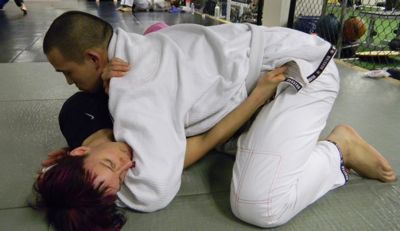
Worse: Blocking the hip. Notice how far my opponent can get into side control progression by this point. My arms are so short, he’s almost in full side by the time I can even reach his hip. He can put almost all his weight on me and he’s secured crossface.
Of course, this isn’t the worst case scenario. I’m still getting on my right side (rather than lying flat) and blocking at the collarbone. But it’s pretty bad.
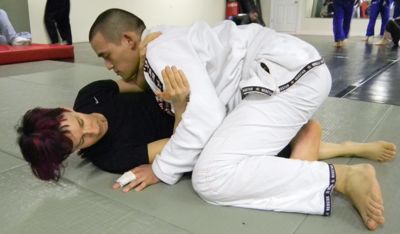
Better: An ounce of prevention is worth a pound of side escapes. As soon as he starts to pass, I get on my side and frame. Top left hand goes in collarbone frame and bottom right hand/forearm blocks the crossface.
The next step for me here is shrimping my butt back to get something else – usually a knee – between me and him.
Don’t push them off you, like trying to bench press them. In fact, try to move them as little as possible. Hold them in place while you move yourself around them instead. Frame, frame, frame.
Another tip from Brian: Forget simply shrimping out of positions because you often can’t dislodge the heavier top person enough; hip bridging is where it’s at. Bridge and shrimp, bridge and shrimp.
Women, your hips are much more flexible and mobile compared to men’s. Your hips are the strongest part of you. Use them.
Female and small person advantages
The average active male is around 10-14% body fat. The average active female is around 20-24% body fat. That means if you have a lean 150 man, around 135 lb of him will be lean body mass, which includes muscle. Only 105 lb of a lean 150 lb woman is likely to be lean body mass. Thus, ladies, even if you’re weight-matched to a dude, he’ll be stronger. C’est la vie.
Nature has, however, gifted us with other things. It’s easy to get all bummed about what you think you don’t have. Start looking for what you DO have.
Women’s hips will be more flexible and you’ll be able to get more femur (thighbone) turnout. This means a good wide base and lots of lovely submission setups. In side control, sit back and wide into your hips.
Men have less flexible spines and shoulders than women, so if you can control these pieces well, they’re less able to wiggle out of positions and it takes less pressure to keylock them.
If you’re smaller and female, one of your go-to submissions on male opponents should be the omoplata. This is pure female advantage versus male disadvantage, because it works well for attackers with shorter legs and more flexible hips, and it’s easier to finish if your opponent’s shoulders aren’t flexible. You’d think that you need longer legs for this one, and that has its own pluses. But the setup is so much easier with shorter legs – just zip your little stump under the armpit and over the shoulder, and Bob’s saying uncle.
This also means that if you’re female, you have a better chance of escaping things like kimuras or omoplatas. I’ve seen women get out of positions that would have dislocated a man’s shoulder. (Of course, it also means that if you’re fighting another woman, you might not go for shoulder submissions right away.)
You can also set up a gogoplata easily from that omoplata attempt – again, shorter limbs and flexible hips work to your advantage. This brings me to another group of submissions that you should have in your arsenal: chokes. Learn your chokes, ladies. The soft tissues of the throat and neck are a prime weak spots and they should be easily available to you if you’re working on your head/neck control anyway.
Smaller people can fit through openings better and zip over and under opponents’ bodies. Huge plus. For me, taking the back is awesome. I’m all over people’s backs like an angry little monkey. Consider getting the back a key objective if you’re smaller and mobile.
Being smaller gives you a lot of openings. Swim for things. You can sneak through little spaces. Start looking for where larger opponents give you openings; you’ll find them everywhere once you start hunting for them. Then use your frames to sneak through those doors.
For example, here’s a fun little trick I got from Brian Peterson that gives you an underhook from the bottom position in half guard. Swim your top knee under your opponent’s chest up into their armpit, and use that knee/shin to feed you their arm for an underhook. I use this one all the time because agan, my little knees are able to get between us so easily.
“Small person sneaks out of half guard” sequence
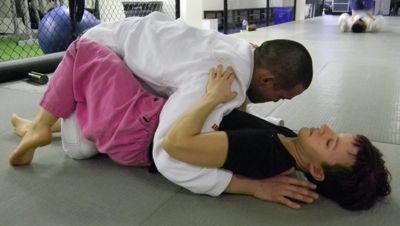
Step 1:My bigger opponent has taken top position in my half guard. I don’t have an underhook, and I want one! But right now his weight is pressing down — I can’t get in there. If I stay on my back, he’s going to drive his upper body into my chest. I’ll be mashed flat and he’ll pass.Keeping my right leg hooked, I release my left leg, and press off it into a slight hip bridge to give myself some room.
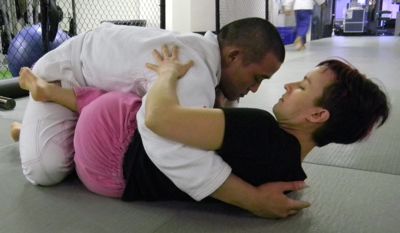
Step 2: Bridging off my left foot gives me room to sneak my left knee into my opponent’s hip as well as turn more on my right side. This frames against him, preventing him from flattening me and advancing. I keep my right leg hooked on to his right leg throughout.
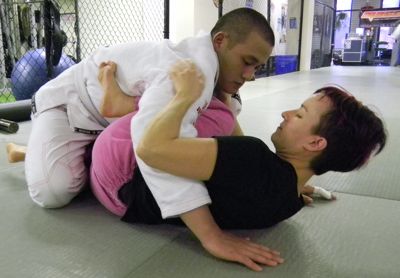
Step 3: I sneak my left knee up and under my opponent’s chest, circling the knee out to get under his armpit. Notice how this is possible because my shin is so short relative to his chest. I keep my left foot hooked, pressing against his ribs.
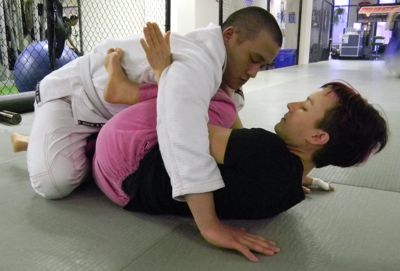
Step 4: I make space under his arm with my knee and shin, and swim my left hand/arm through.
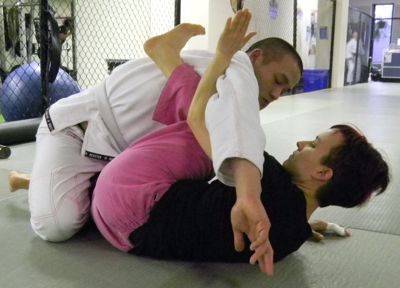
Step 5: I use the combined push from shin and arm to bring his arm up, and get the underhook. Notice how I don’t just pull with my hand, but drive my whole arm in. This pushes his shoulder into internal rotation, which also weakens the joint.
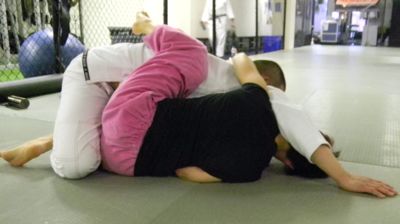
Step 6:I keep moving to my right side, and “scooch” down lower, closer to my opponent’s hips. My right leg will become my right hook as I move into back control. I pop my head back out through the armpit hole.Now I’m on your back, sucka!
If you’re smaller, it’s often harder for them to choke you. Bonus! So don’t panic when you’re in a choke setup; learn some good escapes and rest assured that the big folks often have to work a lot harder to take away the space around your skinny pencil neck.
Beyond technique
Now, grappling isn’t just about techniques, of course. There are social dynamics as well.
Take charge of your own training. You are the boss of your experience. You choose not to roll with people who will damage you. You can choose to stop a roll if you are uncomfortable, or to set the terms of engagement. It’s YOUR training. Take control of it.
Don’t be afraid to assert yourself. Your safety and wellbeing depend on it. You can be the toughest fighter on the mat, but the laws of physics still apply to you. Force equals mass times acceleration, and you’re on the losing end of that equation. Be smart. You don’t have to “prove” anything to anyone. You’re here to learn grappling, not impress people.
Define your requirements to your partner clearly. Many guys just don’t know how strong they are in relation to you. If you need them to use less strength or less weight, say so. Most are simply unaware of how much more powerful they are. And most guys are decent and happy to be accommodating. Help them help you by being upfront and clear about what you need.
If possible, don’t roll with white belt guys who outweigh you by more than, say, 10 lbs, unless you know for sure you can trust them. They are spazzy and lack control; they WILL hurt you. This is usually unintentional, but it can be purposeful too. I had my elbow sprained by a 13 year old kid on his second day of training — he busted out an armbar he’d probably seen on UFC and he was so big I couldn’t defend it, even though I was a blue belt. I nearly had my shoulder dislocated by some 170-lb dickhead in my second week of training, who then proclaimed himself “the armbar king”. (2 years later, Armbar King had the crap kicked out of him by a much bigger, judo black belt female friend of mine. Revenge is sweet.)
If you can’t avoid being paired with a spazzy white belt who’s bigger, set some terms, e.g. “Can we just work on drilling X sequence at 50% resistance instead of a full-on roll?”
As a corollary, it may seem counter-intuitive to seek out higher belt males, but they are better partners. They’ll have more control and most of the time they’ve gotten over their ego issues. You can roll more safely with a bigger but experienced male. I’ve worked safely with a guy who was over 300 lbs — he was a black belt. Basically, the bigger they are, the higher the belt they should be in order to be trusted around you (with the exception of the brown belt example below, sadly).
If the guy is going to be a jerk about it, don’t work with him. Some assholes get off on submitting little women because they can’t tolerate the ego threat of the woman out-techniquing them, or it makes them feel like a stud to smash someone weaker. Submitting someone you drastically outweigh simply by muscling through a technique is about as cool as punching a 7 year old. I once heard a big male brown belt complain about how women weren’t “tough enough”. I’d like to see him fight someone who is double his weight and see how tough he feels when 400 lbs is crushing his yapping mouth into the mat.
Again, you WILL get hurt if you work with these kinds of guys. Don’t try to be a heroine. The injury isn’t worth it.
Ask your instructor for support on this issue and ensure that you are paired up with safe and appropriate training partners. If your instructor does not support you, find another place to train.
The good news is that you CAN train safely and there are plenty of supportive, helpful, appropriate male training partners out there. But you have to understand and respect the 3 Ps: physiology, psychology, and physics.
And if you’re in Toronto, come out to our free women’s classes at MECCA! 🙂
About the Author: Krista Scott-Dixon trains BJJ and submission grappling in Toronto, Ontario, Canada. She also operates the renowned women’s fitness site: Stumptuous.com
| If you liked this article you might also enjoy these related pieces: | If you’re looking for more information on BJJ and self defense please download our FREE book, A Roadmap for Brazilian Jiu-Jitsu
|