


Maybe you travel a lot. Maybe you live in a really small town. Maybe the club you used to train at closed down. Maybe it’s just too far to go to train regularly. In any case, training partners or good training environments are sometimes hard to find. So what do you do?
Here are some tips and ideas I have used to keep my grappling skills alive even when I’m hundreds of miles away from a skilled sparring partner.
Some training is better than no training
- Try to find a club nearby. There are lots of schools nowadays – maybe there’s a good one near you that allows dropins.Consider making a weekly or monthly pilgrimage to a club, even if it is a long way to go. Some mat time is better than no mat time. Even one session can give you some material to add to your repertoire.
- Find a local judo or wrestling club – this will develop your takedowns as well as developing your skill in certain aspects of grappling.
- Bring an instructor to you. This could range from occasionally inviting an instructor to teach your group, all the way to sponsoring a black belt from Brazil
- Practice your fundamental movements by yourself (e.g. escaping the hips, bridging, shooting, sprawling, etc.). Boxers shadowbox, why shouldn’t grapplers shadowgrapple?
Improve Your Conditioning
- Conditioning is very important, ESPECIALLY if you have aspirations of competing. Being in shape will help you when you finally get back onto the mat with some skilled people. Here are some articles I’ve written on the topic of conditioning for BJJ and MMA.
- For cardio conditioning the minimum that you need is a pair of running shoes. Running was good enough for Mohammed Ali, so it should be good enough for you. You can also use treadmills, stairmasters, elliptical trainers, etc.
- For strength training, find a gym. At the very least you can find a bar or treebranch for doing pull-ups just about anywhere in North America. Level surfaces for pushups, burpees and crunches are also abundant.
- If it helps you, find a training partner to encourage you, spot you and drag your ass off the couch when you’re not feeling motivated.
- Do Yoga, pilates, spinning classes, aquafit, etc. Doing something is better than doing nothing.
- Commit to competing in a 5 or 10 kilometer race or a beginner’s triathalon. These are relatively common and will motivate you to keep up your cardio conditioning.
- Watch your nutrition. If you normally train a lot and have a sudden decrease in your training quantity then cut back on how much you eat! You don’t want to gain any bad weight that will hamper your efforts to improve your skills.
Create Your Own Training Group
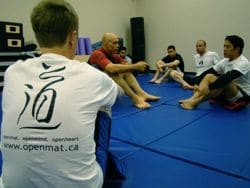
- Find some interested beginners and create a training group. Teach them and let them teach you. I firmly believe that you can make pretty good progress, even without a formal school or instructor, so long as you are motivated and have some good training partners.
- When teaching people who are not as good as you, don’t hold back on the instruction. You want to improve the level of your training partners so that they challenge you – this way everybody gets better.
- When sparring beginners allow them to start with you pinned or nearly submitted – work your escapes!
- If any of the people you are teaching have a specialty (e.g. judo, wrestling, boxing…) make sure that you spend some time in that person’s comfort zone. Check your ego at the door and do some learning yourself.
- When sparring with beginners use only one submission technique for the whole session. If all you are using is a straight armbar they’ll get pretty good at defending it and you will get much better at figuring out answers to their counters. Next time switch to a different technique.
Train your mind
- You can learn so much from instructional videos these days (both mine and other people’s). In lieu of having a regular instructor you CAN learn from watching videos, especially if you can occasionally try out the techniques on somebody’s body. A lot of top instructors have helped a lot of people with a lot of material.
- Watch footage of competition. This will familiarize you with a great number of strategies and techniques. Be analytical and watch good matches more than once to see what is going on.
- Read books – there are many great old Judo books and many great newer Jiu-jitsu books. There is also a lot of literature on conditioning – I find the running books to be particularly informative.
- Use Youtube (doh). There is a huge body of knowledge and techniques out there – you just have to find it and winnow out the good material from the chaff.
- Obviously it’s best to have someone to practice with, but visualization is also a valuable tool. Try to visualize the technique you want to develop in every small detail. How do you shift your weight? How do you stop your opponent from moving, or how do you encourage them to move? Which muscles do you use? Where, exactly, are you making contact with your opponent at every stage of the technique?
So you can now see that there ARE a lot of options for you, should you be looking to acquire or improve your grappling skills but don’t have regular access to a club and an instructor.
Ultimately, where there’s a will there’s a way. There have literally been UFC champions who started out watching tape and practising in a garage with friends.