

Of all the fundamental BJJ positions, there’s one that shows up MUCH less often than the others in modern jiu-jitsu competition.
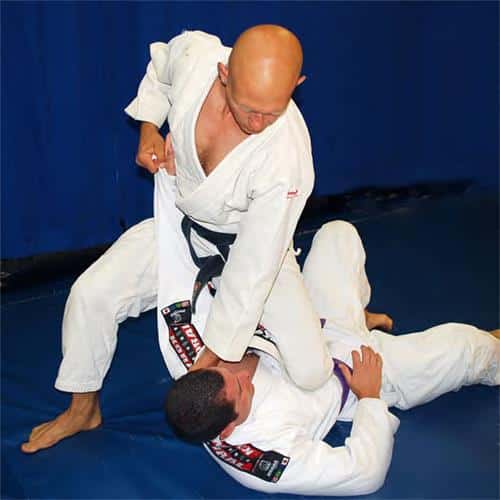
That missing position is the knee mount or the knee ride. In high-level competition, you see guard, side control, mount, back and turtle all the time, but knee mount hardly ever shows up for more than a moment or two.
In part, this is because knee mount is a transitional position – pinning the other guy with your body weight transmitted through the knee buys you a moment or two to adjust your grips, finalise the guard pass, and/or set up your transition to the next position.
Another factor in the relative rarity of competitive knee mounts is the rise in the popularity of leg entanglements: 50-50 guard in the gi, and leglock entanglements in no gi (check out Uno Reverse Card escape from No Gi Pin Escapes set for a great example of this).
So why practice knee mount at all?
Easy!
BJJ is not only a martial sport, it’s also a martial art, and that means knowing how to use it for self defense.
Knee mount is the MOST powerful position for striking on the ground. Your relative elevation and freedom of movement allow you to deliver an overwhelming left-right-left-right blitz of KO punches in just a few seconds.
Furthermore, knee mount allows you to monitor both his hands to see if he’s going for a weapon, control him until help arrives, and – if necessary – quickly disengage to run away if you see his friends showing up.
So don’t throw the baby out with the bathwater. It’s true that you probably won’t see the classical spinning armbar from knee mount win the Mundials or ADCC anytime soon, but the knee mount could still be a self defense ace up your sleeve.
Cheers,
Stephan Kesting