


Originally published in Grappling Magazine (August 2005 issue)
The ankle lock has a long and varied history. This technique was used by many of the traditional Ju-jutsu schools in medieval Japan, North American Catch Wrestling as well as in pre-World War 2 Judo.
Then it fell onto hard times. Judo banned the ankle lock. Catch Wrestling faded in prominence. Brazilian Jiu-jitsu never actually banned ankle locks completely, but using them was considered crass and low class.
In the early days of BJJ in North America, if you used a footlock at a Jiu-jitsu tournament you were likely to get boo-ed by the audience!
If you do the ankle lock correctly you can use it to submit people in BJJ, submission grappling and MMA. This article is all about the principles and details that make it an effective submission.
Despite the negative stereotyping of foot and ankle locks, there were always Brazilian Jiu-jitsu players who used these submissions. My Jiu-jitsu coach, Professor Marcus Soares, was an ankle lock aficionado when he trained in Brazil, and even earned the nickname “Bicho-do-Pé”, a type of foot fungus like Athlete’s Foot, because of his use of this submission.
In the last 5 years, however, the ankle lock, or Achilles hold as it is sometimes called, is experiencing a renaissance in the grappling world. Royler Gracie himself has used the ankle lock quite extensively in the prestigious Abu Dhabi Combat Championships, and there are countless examples of elite grapplers beginning to use it to win both gi and no-gi competitions.
Why this resurgence in interest? I believe there are several factors.
One reason is that in the last 10 years instructors and competitors like Erik Paulson and Oleg Taktarov have exposed grapplers to such arts as Sambo, Catch Wrestling and Shootwrestling, all of which use a lot of leglocks. As these leg-oriented arts came into the limelight, grapplers everywhere were exposed to these novel, but effective, submissions.
In addition, early Japanese mixed martial arts in the early 1990’s used many techniques from Russian Sambo, Judo, Japanese Jujitsu, Catch Wrestling, and Thai Boxing (the influence of Brazilian Jiu-jitsu, although important, came later). One of the main consequences of this lineage is that Japanese grapplers came to rely on Sambo and Catchwrestling leglocks.
Frequent leglock submissions in these matches left little doubt that knee and ankle locks could be effective, even devastating, techniques.
Finally I believe the increasing popularity of no-gi grappling also helped propel leglocks in general, and ankle locks in particular, to prominence. Without the gi there are simply fewer submissions available, and some old standards like lapel chokes are impossible to apply. By cross-training with grapplers from other disciplines, no-gi competitors expanded their focus to include the legs. They were not content to limit their submissions only to the upper half of the body.
The leglock family includes ankle locks, kneebars, toe holds, heel hooks, shin locks, calf crushes, hip cranks and other submissions. In this article we are going to focus only on the ankle lock, in which there is no twisting action applied to the knee or foot. This fundamental submission is fairly safe, and is a great starting-point for other leglocks.
Hopefully this article will open your eyes to a great submission. If you’ve never tried ankle locks before I can only encourage you to start. Why limit your submissions only to the upper half of your opponent’s body. If you’re already using ankle locks, then hopefully I’ll show you some details and variations to make your ankle locks even more effective!
The Anatomy of the Ankle Lock:
The ankle lock submits your opponent by using by using at least two different pressures: foot hyperextension and Achilles tendon compression. Depending on the exact grip you are using, the size of your forearm, and the anatomy and pain tolerance of your opponent, he may feel one or both of these pressures at the same time.
The ankle lock becomes dangerous to the knee only when your opponent spins wildly in an attempt to escape. This escape can be dangerous and is not always effective. If your training partner tries to escape in an unsafe manner it is better to release the lock and let him go, rather than endanger the ligaments in his knee.
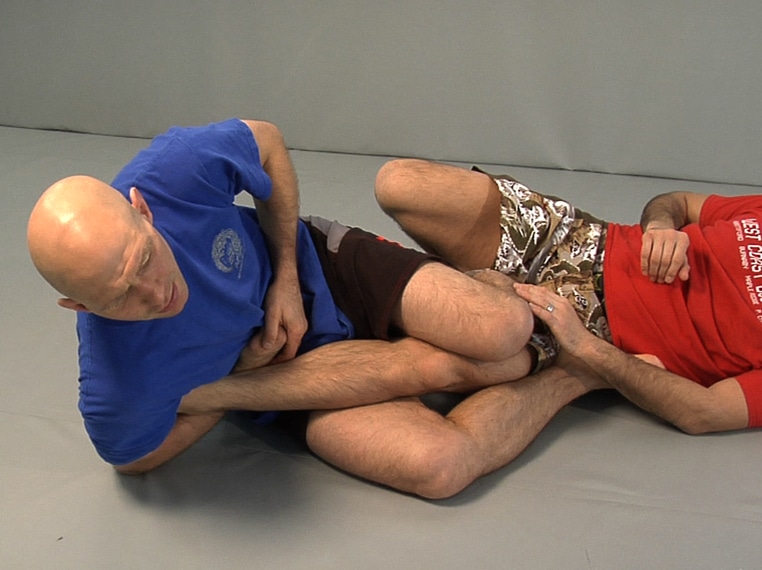
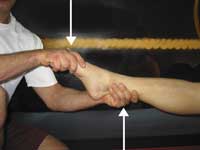 Pressure 1: Foot HyperextensionThe first pressure is the hyperextension of the foot. This photo shows what I mean: his toes are moving away from his shin, stretching the muscles and ligaments on the topside of his foot. This causes pain and forces him to submit.
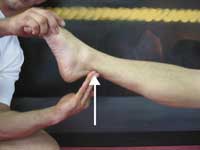 Pressure 2: Achilles CompressionThe second pressure is compression of the Achilles tendon.
Here the bony part of your forearm is pushing into the Achilles tendon right where it attaches to the heel (see photo for location). This also causes pain and forces him to submit.
ANKLE LOCK GRIPS AND VARIATIONS:
There are a number of ways to grip your opponent’s foot, and I am going to show you a few commonly used grips. There are also many types of ‘novelty’ grips that are rarely used in real competition, but that are still handy to know about.
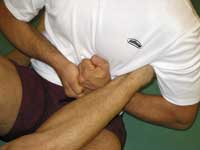 1 – Fist in palm (or ‘cup and saucer’) method.
This is a very effective method of applying the ankle lock, but is often used incorrectly. Loop your left arm around your opponent’s right ankle, and then place your left fist is in your right palm.
Now make sure that the boniest part of your left wrist drives into the bottom of his Achilles tendon, just above where it attaches to the heel. It is very difficult to properly apply this lock if you are trying to apply it too high upon your opponent’s leg.
Keep your hands HIGH on your body, near your own solar plexus. If you hold your hands too low, say below your belt line, there is too much slack to properly apply the lock. If you are wearing a gi you can also grab your own lapel to keep your grip snug and high.
Note that for clarity’s sake in the photo my elbow is flared out – for maximum effectiveness my left elbow should be tucked against my ribs, removing space that could help an opponent escape.
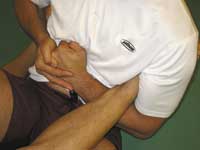 2 – Fist in palm, deep forearm placement.
Some grapplers prefer to have the fleshy part of the forearm under the ankle, rather than the bony part of the wrist. They feel that this increases control over the foot. This method relies on foot hyperextension more so than Achilles compression to submit your opponent, because you just don’t have as sharp an object (i.e. your wrist) to bend his foot over top of.
You should experiment with both shallow and deep placements and see what works best for you.
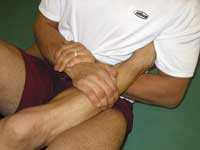 3 – Figure 4 grip.
This is one of the most common methods to apply the ankle lock. Because your forearm is flat against your opponent’s Achilles tendon, the ‘bite’ on his Achilles (and resultant Achilles compression) is somewhat reduced, however you do have excellent control over his foot.
I often switch to this grip when my opponent is flexing his foot, trying to prevent me from hyperextending his ankle. Switching to the figure 4 grip gives you a greater ability
to straighten his foot out and hyperextend his ankle.
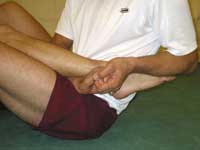 4 – Wrestler’s Grip.
Here you interlock the fingers of both hands so that you are forcing his foot to hyperextend with the back of your hand and forearm.
This grip is rarely used in competition, but is an interesting variation to experiment with.
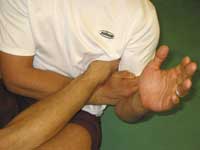 5 – Bicep Grip.
Here you are using the opposite forearm to apply pressure to his Achilles tendon. This variation is rarely used, but has definite potential if your opponent is controlling one of your hands and makes it difficult to apply one of the other grips.
Leg Positioning for the Ankle Lock
The role of the legs while applying the anklelock is also critical. Fundamentally you will use your legs to ‘quarantine’ his foot, taking away his ability escape your pressure by moving his knee or hips. The feet also stop him from coming towards you with his body, which would also relieve pressure on his foot.
Some leg positions also make it difficult for your opponent to stand up, which is a very common counter to the basic ankle lock. There are many variations of leg positioning, and here I will go through a few of the more common options:
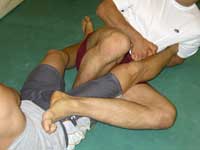 1 – Foot on Belly. Here you are lying on your side, attacking the foot closest to the floor, with your BOTTOM foot in his belly.
This bottom foot pushes his hip and belly away from you, making it difficult for him to bring his upper body close to you.
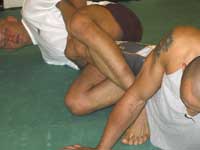 2 – Foot on Floor.This position is similar to the first position, but you are lying on your other side, attacking the foot closest to the ceiling, with your foot resting on the floor instead of his belly.
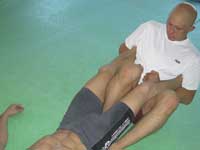 3 – Double Leg Grip.Here you are holding both his ankles, and NEITHER of your feet is over his legs or belly. This variation requires you to maintain the grip on both the leg you are attacking AND his free leg: if you release his free leg he will stand up and escape.
Usually you use this position as a transition to another leg position.To see a photo of this grip in action click here.
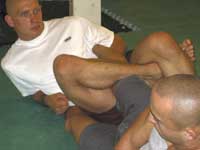 4 – Triangled Legs.In this variation you triangle your legs around the leg you are attacking. This creates a very tight lock on your opponent’s leg, but you have to attack fast because it is difficult to stop him from standing up!
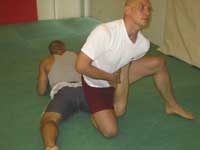 5 – Belly Down.This position is used when you have turned your opponent onto his belly and you are kneeling or lying on your own belly. It is a very powerful position and leaves your opponent with very few escape options.
Sample Leglock Attack Sequence
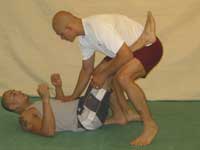
1, Stephan starts in his Denis’s open guard.
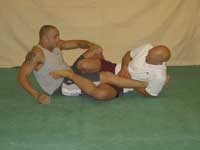
2, He falls back and attacks with an ankle lock using the ‘cup
and saucer’ grip and putting his foot on his opponent’s belly
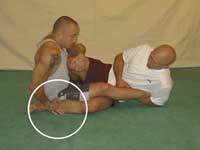
3, Denis counters by pushing Stephan’s foot to the
floor and sliding his hips on top of the foot
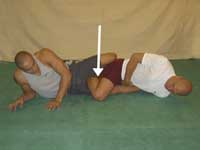
4, Stephan counters Denis’s counter by sliding the
knee of his other leg over his opponent’s thigh…
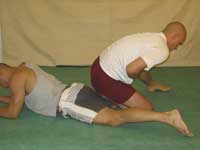
5, …turning his belly down to face the ground, and starting to sit up
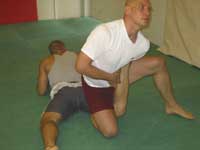
6, This is a very powerful finishing position: you can arch backwards
and really apply a lot of pressure to your opponent’s ankle.
But you can also still submit him with the ankle lock even
if you can’t sit up and end up lying face down on your belly.
Get the step-by-step blueprint for adding high level leglocks to your game. Click here for more info about the Grapplearts Leglock DVD Package!
This highly acclaimed material includes entries, setups, principles, counters, drills, strategies, and combinations.
Other Leglock Resources include:
Thanks to MMA sensation Denis Kang for helping me out by posing for these photos – it has been a long time since I managed to ankle lock him for real!