


A Technique that Bridges the Gap between Sweep and Submission
By Stephan Kesting
Originally published in Grappling Magazine in 2002.
The omoplata is all the rage these days: it’s a submission, a sweep, and a setup for other submissions and sweeps. If you go to a high-level grappling competition tomorrow, you will almost certainly see it used multiple times.
The omoplata is a little bit difficult to describe in words, and even photographs sometimes have difficulty capturing the essence of this dynamic attack. In the very basic version, you are applying a Kimura shoulderlock (also known as a chicken wing) with your legs instead of using your arms. Most often it is applied from the guard, but can be used in many other positions as well.
Believe it or not, I first came across omoplata as a finishing hold in Indonesian Silat. After a bit of experimentation I found that I could also apply it while wrestling around on the mat. Boy was I proud: I thought I had developed a unique grappling attack that no one else had ever thought of! I was soon to get a reality check though: first I found some older Judo books that included an attack very much like omoplata.
Then, as I became more and more wrapped up in Brazilian Jiu-jitsu, I gradually began to realize that the Brazilians had been doing this attack while grappling all along. Oh well…
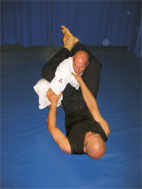
Technique 1: Triangle choke to Omoplata
Although the omoplata has been around for a long time, it is currently undergoing a renaissance of sorts. Marcus Soares, my Jiu-jitsu coach and a 6th degree black belt under Carlson Gracie, states that the omoplata only started to be used with any regularity in the mid-eighties.
Then there was an additional burst of evolution in the late nineties, when it became people started to use omoplata as a sweep, rather than a submission.
Nowadays, instead of just being a shoulder lock, omoplata has become the entry into a series of dynamic and powerful guard sweeps, as well as a setup for a whole spectrum of submission holds.
It has made the jump from an obscure technique used in isolation, to a very important component of Jiu-Jitsu that every groundfighter needs to understand. I cover more than 50 of these attacks, variations, followups, drills and counters in the DVD “Omoplata and the Dynamic Guard”
The omoplata is also a very important in grappling without the gi (i.e. submission grappling). This is because the submission options from the guard are relatively limited without the gi, which normally provides handles and choking opportunities.
There are traditionally FOUR major no-gi submissions from the guard: the armbar, the triangle choke, the guillotine and the Kimura armlock There are of course other submissions available, but for years these four have been the ones you see most often.
A fighter who includes the omoplata in his guard attack repertoire goes from four to five primary attacks: a 25% increase in high-percentage attacks. Nino Schembri and Jean-Jacques Machado immediately come to mind as masterful practitioners of the omoplata in submission grappling competition.
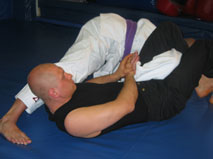
Technique 2: Omoplata to wristlock
A couple of years ago I was arguing with an up-and-coming NHB fighter that he should consider adding the omoplata to his guard-attack repertoire. “No way”, he replied, “that attack is WAY too risky”. At the risk of sounding a little smug, some NHB luminaries have started using it quite successfully since I had that conversation. Fighters such as Antonio Rodrigo “Minotauro Nogueira, Matt Serra, BJ Penn and others have made good use of the omoplata while competing in the ring or octagon.
Part of the reason for the success of omoplata in NHB is that this attack places you mostly out of the line of fire of your opponent’s strikes. Also important is the fact that you can transition smoothly and easily from omoplata to the armbar, triangle, and other attacks.
The best example I can think of for this type of attack flow was in the Pride Fighting Championship 19, where Brazilian Top Team prodigy Antonio Rodrigo “Minotauro Nogueira faced off against the very tough and talented veteran Enson Inoue.
The fight went to the ground quickly where Minotauro attacked with a text-book example of the lock flow strategy. In close succession he attacked with a Kimura from the top, a Kimura from the bottom, an omoplata, a toehold, back to the omoplata again, and finally choked Enson unconscious with a triangle attack. Although he didn’t finish Enson with the the omoplata, it was central to controlling him on the ground and setting up the big finish.
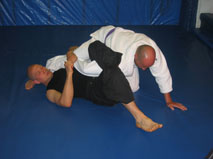
Technique 3: Scissor sweep to Omoplata
With the omoplata, as with most other sweeps and submissions in grappling, it is important to understand not only the mechanics of the attack, but also the entries and setups for the attack. You must understand the timing and positions which allow you to successfully attack with omoplata. You must also be able to trick or force your opponent to give you the correct timing and position: this is ‘setting up’ the attack.
In this article I’ve been sharing four of the about thirty very effective setups from my video “Omoplata and the Dynamic Guard“. I am sure that with a bit of experimentation and research you will discover some additional setups of your own.
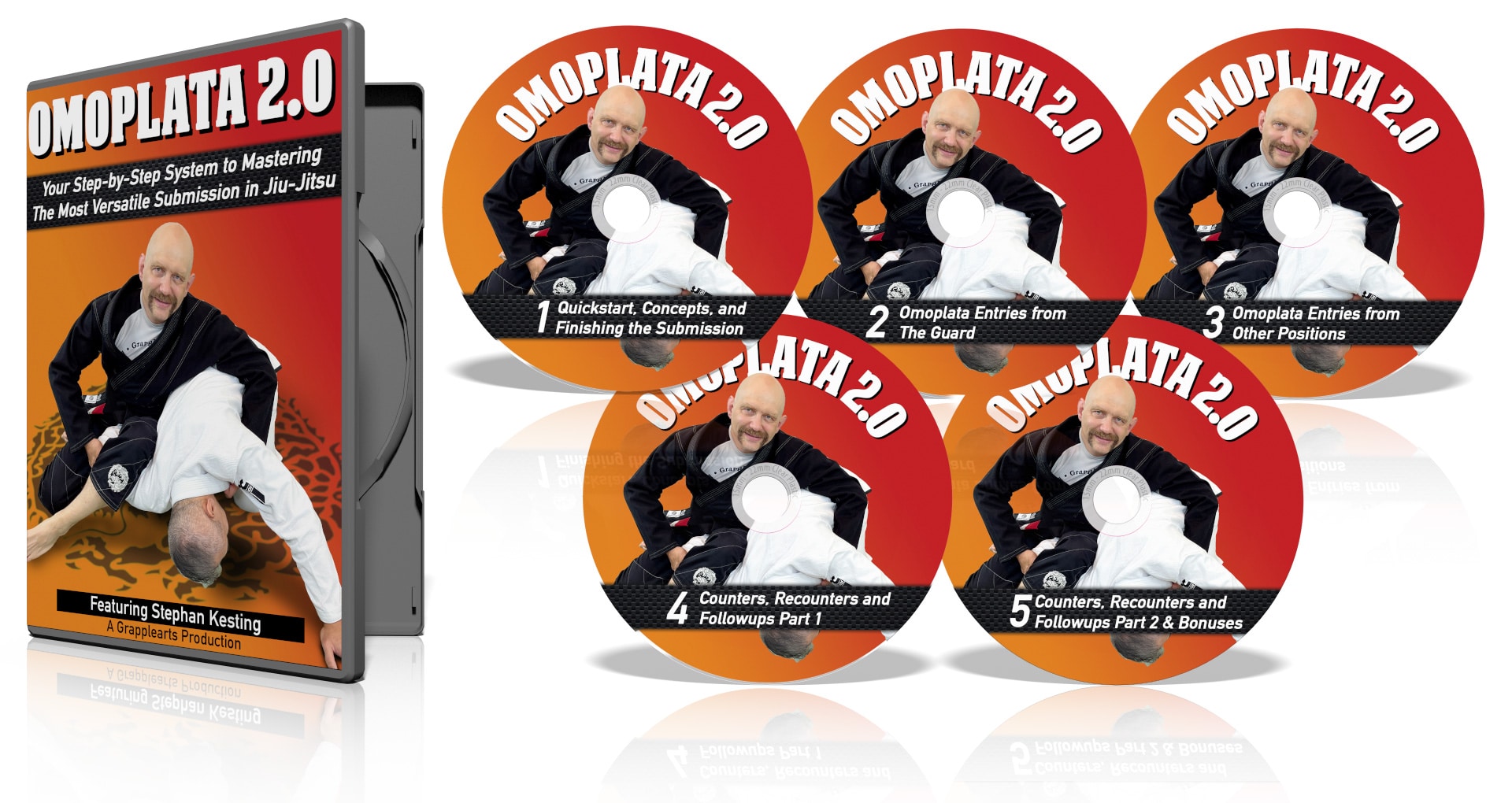
(Please note, this is an outdated instructional and has been replaced by the vastly improved Omoplata 2.0 instructional).
Just as there are different ways to get into the omoplata, there are different ways to submit sweep or turn over your opponent once the technique is applied. In this article I show the basic shoulder lock finish, the wristlock finish and the footlock finish. Keep in mind that there are more dynamic sweeps, turnovers, chokes and locks out there, waiting for you to discover them.
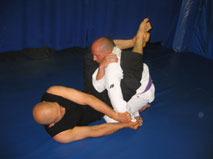
Technique 4: Omoplata to Footlock
Some important tips for the omoplata include
- Tightly triangle your legs while applying the technique to prevent your opponent escaping his arm. You may have to open your legs at a later stage in the attack to finalize the submission, but keep it tight until you have your opponent under control
- Be ready to apply the omoplata anytime your opponent overhooks one of your legs while trying to pass your guard
- Try to get your body lined up opposite to your opponent’s body: your head should be near his feet and your feet near his head
- As soon as you have applied it you need to stop your opponent from stepping over your head. Some basic ways to do this include sitting up, grabbing his belt or hooking his near leg with your arm
- Practice regaining the guard or half-guard if your opponent manages to yank his arm out of danger. You are in danger of having your guard passed unless you anticipate this response and adapt your game accordingly
- Try to learn as many setups and follow-ups to omoplata as possible. You can learn or develop drills to help make these techniques instinctive. Also try to learn different counters, both to use them yourself and to prevent your opponent from escaping from your submission once it is sunk in.
Good luck in your training. With a bit of diligence, research, experimentation and ingenuity I am sure that this will be the beginning of a beautiful relationship between you and the omoplata!
Stephan Kesting
P.S. When this article was published back in 2002 the best information on the omoplata was my “Omoplata and the Dynamic Guard” instructional, first released as a 2 volume VHS tape set and then later also on DVD.
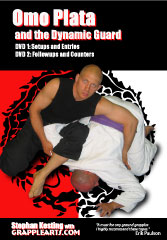
The omoplata has remained one of my cornerstone techniques, but the way I apply it and finish it has become much more sophisticated over the years.
The technical advances I was making for this technique eventually demanded that I update, expand, and improve this instructional, and I recently refilmed a vastly improved version of the instructional.
That new instructional is called Omoplata 2.0 and it’s a highly reviewed tour de force that gives you a complete system for the most versatile submission in jiu-jitsu.
If you get Omoplata 2.0 I’ll include the original instructional (Omoplata and the Dynamic Guard) as a bonus, just so you can see how much the art has evolved.
Anyway, check it out here. I really think this is one of the best instructional sets I’ve ever produced.